
PHOTO
77986.0
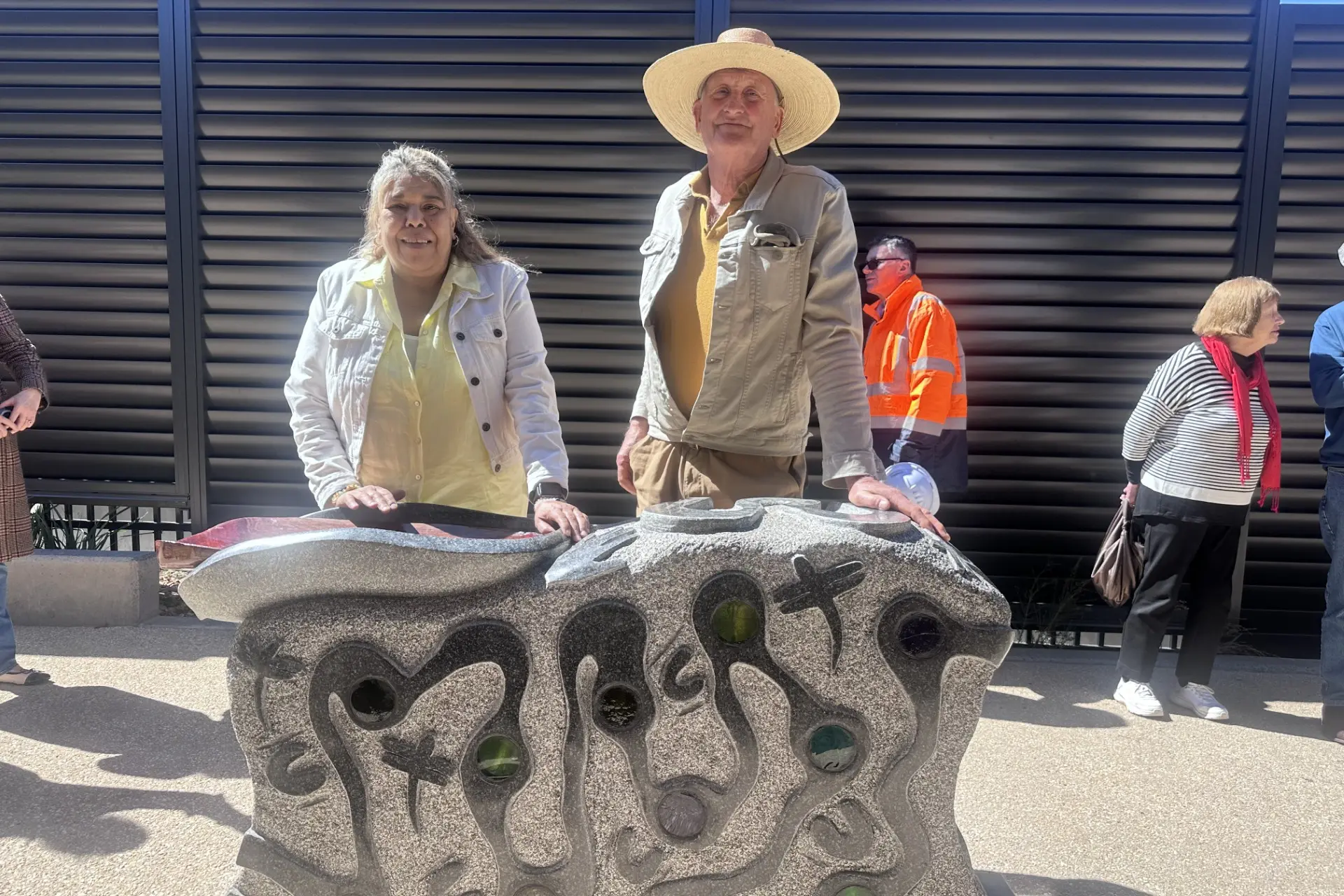
A piece of Wiradjuri Country has been carved into the heart of the new Cowra Hospital, with artists Diyan Coe and Kenneth “Ken” Hutchison combining culture, stone, timber and generations of birthing knowledge to create a sculpture specifically for the hospital’s maternity courtyard.
Titled Birthing Pools, the work was created by Mr Hutchison in collaboration with Wiradjuri artist Coe and retired midwife Helen Isaksen, bringing together artistic practice, Aboriginal cultural knowledge and experience in maternity care.
Made from Wiradjuri black granite from Eugowra, billet glass and a Eucalyptus redwood coolamon with possum skin, the sculpture is much more than a decorative addition to the $114.3 million hospital redevelopment.
Every part of it has been deliberately designed to tell a story about birth, women, Country, water, family and the generations of knowledge surrounding the arrival of a child.
The sculpture is one of more than 30 new artworks commissioned for the Cowra Hospital, with artists selected through an Expression of Interest process focused on those living locally or with a strong connection to Cowra and the surrounding region.
For Ms Coe, the cultural meaning behind Birthing Pools begins with the understanding that childbirth has long been surrounded by its own knowledge, responsibilities and protocols.
She explained that some elements represented in the sculpture relate specifically to women’s business and therefore cannot be completely explained publicly.
“That’d be in women’s business in Aboriginal culture, or in our culture, where men aren’t allowed to be around the women’s business and women aren’t allowed to be around men’s business,” Ms Coe said.
“I can’t go into it too much.”
What can be shared, however, reveals how deeply the sculpture is connected to Wiradjuri understandings of childbirth.
Flowing lines carved into the work represent running water, while circles and glass inlays signify water pools.
Around those pools are crescent forms and etched ovals representing senior women and midwives carrying coolamons, with the shapes mimicking the impressions left in the ground when sitting cross legged.
“The waterways is the water running,” Ms Coe said.
“The circles represent waterholes.”
The imagery also connects directly with Ms Coe’s paintings within the hospital’s birthing suites, creating a continuing story between the indoor maternity spaces and the courtyard sculpture.
At the centre of the piece is the coolamon.
Traditionally used to carry babies, the coolamon would be lined with possum skin to provide warmth and comfort.
Mr Hutchison carved the granite specifically to support the redwood coolamon, which can be housed within the sculpture when it is not being used.
The finished work invites families to place their newborn baby in the coolamon for a photograph, creating a moment that connects the arrival of a new generation with Cowra, Wiradjuri Country and the cultural stories represented throughout the sculpture.
Ms Coe said the work also recognised the people who surround mothers and babies through childbirth, including elders, midwives and healthcare workers.
Light itself carries meaning.
Ms Coe described health workers as dragonflies, saying they represented a source of light through what they provide to others.
“[Dragonflies] might be only small, but they have a whole lot ... to give to you,” she said.
“So that’s what they represent.
"I see health workers as light.”
That idea was translated physically into the sculpture through glass and the way sunlight moves through the work.
For Mr Hutchison, achieving that effect became both an artistic and technical challenge.
“The light coming through the glass was really artistic,” he said.
“I had to add some reflective tubes in there to help boost it a little bit.”
The result changes depending on the time of day, with sunlight passing through the glass and illuminating parts of the sculpture as its position shifts.
Mr Hutchison said the collaborative design process had also given him an opportunity to learn more about Wiradjuri culture, the river and cultural knowledge surrounding birth.
“The design process was terrific,” he said.
“Really, we would sit down and brush stuff out, and I’ve learned a lot of things about the culture of the river and bits and pieces of birthing.”
The collaboration was complicated when Ms Coe suffered a serious injury near the beginning of the project, restricting how much she could physically participate in the making of the sculpture.
Her contribution to its concept and cultural design, however, remained fundamental to the finished work.
Mr Hutchison then faced the task of turning those ideas into stone, timber and glass.
One of the most difficult elements was getting the coolamon to sit precisely within the granite.
“There was about three days of trying to get that to fit in there properly, to get it really, really nice and tight,” he said.
Rather than simply resting two separate materials together, Mr Hutchison wanted the granite and timber to become physically connected.
He cut into the timber with a chainsaw and inlaid those cuts with granite from the stone itself.
“I’ve inlaid a couple of chainsaw cuts on the wood, and that’s been laid with the granite from the stone,” he said.
“So these two objects now are inseparable; they’re part of each other.”
The material itself carries another important connection to place.
Mr Hutchison said the black granite came from Eugowra and welcomed its description as Wiradjuri granite, rather than simply using its commercial name.
“I think it’s absolutely fantastic,” he said of recognising the stone through its local cultural connection.
For Mr Hutchison, that description gives the material an identity grounded in the Country from which it came rather than treating it simply as a building product.
Ms Coe similarly emphasised that the materials were deliberately local, pointing to the granite’s connection with the Eugowra area and the use of redwood in the coolamon.
Together, the materials give the sculpture a physical connection to the region at the same time as its designs tell cultural stories belonging to it.
The granite also serves an important symbolic and practical purpose.
Its strength represents the resilience of women during labour, while the size and shape of the sculpture have been designed so a woman can physically lean against it for support.
At the same time, the work provides a connection with Billa Galari, the Lachlan River, and Wiradjuri Country during the birth journey.
It is that combination of function, culture and storytelling which makes Birthing Pools distinctive within the hospital’s wider art collection.
The redevelopment features paintings, photography, collage and sculpture from local and regionally connected artists, with the collection designed to create a more welcoming hospital while reflecting Cowra’s landscapes, history and people.
But for Ms Coe and Mr Hutchison, Birthing Pools has an especially fitting home.
It sits within a maternity setting where the stories represented in stone and timber continue to happen every day, women giving birth, babies entering families, midwives providing care and knowledge passing from one generation to another.
Ms Coe’s cultural knowledge shaped the story.
Mr Hutchison’s craftsmanship transformed those ideas into a physical object.
Ms Isaksen brought another perspective through her experience as a midwife.
Together, they have created a work that families will not simply walk past.
They can touch it, lean against it, see sunlight move through it and, after welcoming their baby into the world, place their child into its coolamon.
In doing so, Birthing Pools becomes more than an artwork inside the new Cowra Hospital.
It becomes part of the experience of welcoming new life on Wiradjuri Country.