
PHOTO
82556.0
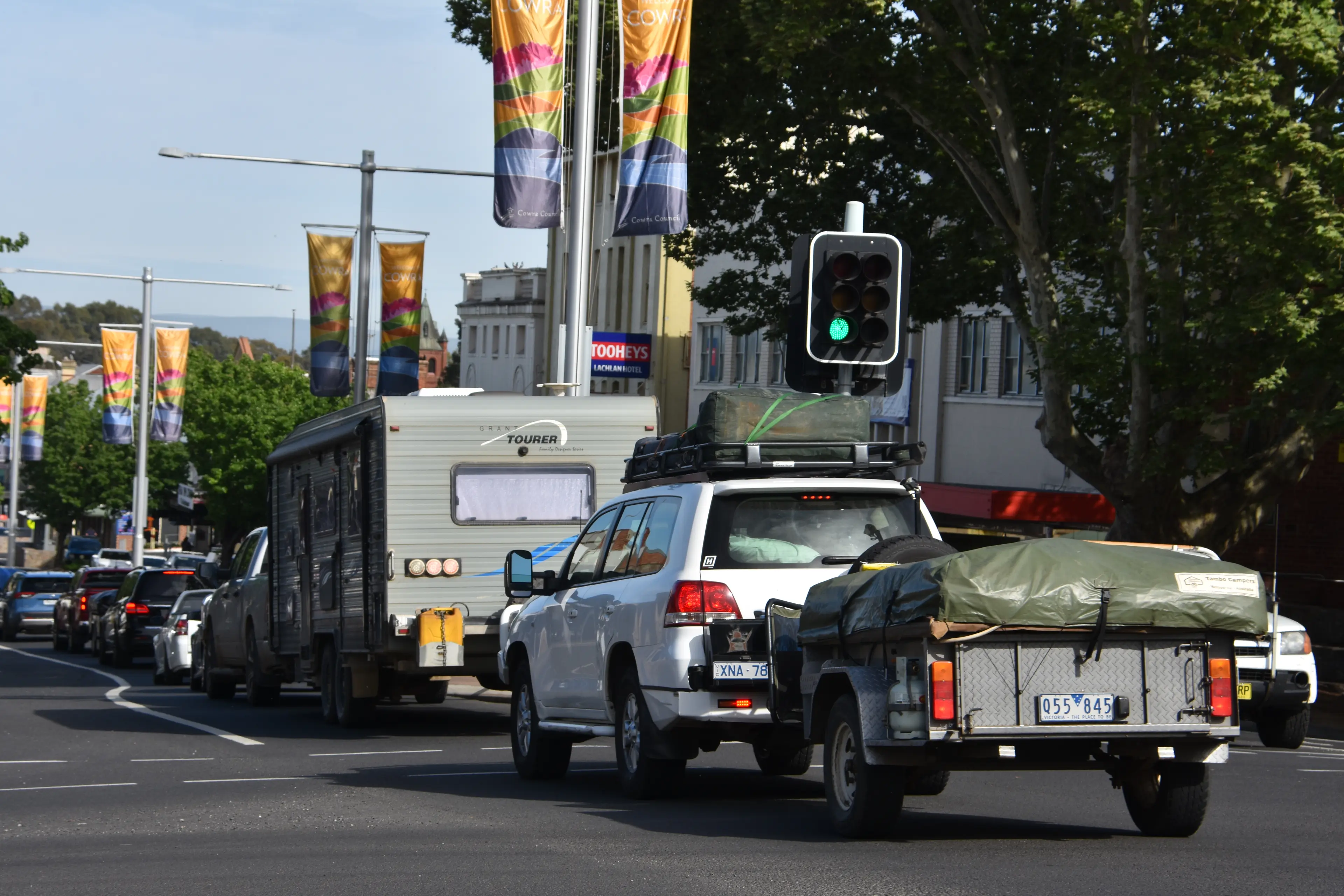
A Transport for NSW proposal to ban right turns at the eastern end of Cowra Bridge has sparked concerns that efforts to ease congestion could simply shift traffic problems into another busy section of the town's CBD.
The proposed changes would prevent motorists travelling east along Kendal Street from turning right into Lachlan Street, instead directing vehicles, including caravans accessing the Cowra Van Park, through Macquarie Street and around the Vaux Street roundabout.
While Transport for NSW believes the restriction will improve traffic flow across the bridge, Cowra Shire councillors have questioned whether the change could create further congestion and pedestrian safety concerns elsewhere.
The proposal was presented at the 19 October Transport Forum meeting, following months of traffic investigations and modelling undertaken in response to concerns about congestion around the bridge.
Cowra Mayor Paul Smith explained that the restriction was primarily intended to prevent caravans and other vehicles from holding up traffic while waiting to turn right at the intersection.
"Transport for New South Wales have told us they intend to put a no right turn sign at the eastern end of the bridge, so that caravans won't be able to turn right into the caravan park," Mayor Smith said.
"They believe that will free up a lot of the traffic off the bridge."
Under the proposed arrangement, eastbound motorists wishing to access the caravan park would continue along Kendal Street before turning into Macquarie Street, travelling around the roundabout and returning via Vaux Street.
Mayor Smith said the change would remove a common cause of delays for vehicles crossing the bridge.
"There'll be no holdups of anyone turning right," he said.
"At the moment, you get a caravan there that pulls everybody up behind it."
However, the proposed solution has raised questions about whether improving traffic flow at one intersection could come at the expense of another.
Councillor Erin Watt expressed concern that redirecting vehicles through Macquarie Street would place additional pressure on an area already experiencing traffic delays and significant pedestrian activity.
"It's just going to create the same problem at Macquarie Street," Cr Watt said.
"It just pushes it up where there's more foot traffic, more delays already."
Cr Watt questioned whether the proposal adequately considered the broader consequences for the CBD, particularly given ongoing discussions about improving pedestrian access and activating public spaces.
"It's going to be a very silly idea, and I think it's just going to create another conversation about the traffic management at Macquarie Street," she said.
Her concerns highlight a central question surrounding the proposal: whether reducing congestion immediately east of the bridge will deliver a genuine improvement to traffic movement or simply relocate the delays.
Macquarie Street is an important part of Cowra's CBD, accommodating businesses, pedestrians and vehicles travelling through the town centre.
Additional turning movements and traffic volumes could therefore have implications beyond the bridge intersection itself.
Mayor Smith acknowledged that the proposal could influence Council's future plans for Macquarie Street.
"This will have an impact on our Macquarie Street plans if this stays this way," he said.
"It will impact on what we can do in Macquarie Street."
Council has previously considered opportunities to improve the amenity and functionality of the town centre, with discussions around pedestrian movement, traffic management and the activation of public spaces.
Cr Watt suggested those broader objectives needed to remain part of the conversation as traffic arrangements were considered.
Referring to a recent Council excursion to Forbes, she noted that streets could still accommodate vehicle movements while providing opportunities for community activity.
"There's a lot of great places we went to on our excursion in Forbes, and you can kind of set up routes and activities in streets that can still work with higher traffic," she said.
However, she questioned whether directing caravans further through the CBD could complicate those plans.
"Obviously, that will create issues if they're encouraging caravans to go further and further away," she said.
"Hopefully we can come up with a solution to still activate Macquarie Street."
The proposed no-right-turn restriction follows a Council recommendation in February 2026 requesting further investigation into options to address congestion around Cowra Bridge.
As part of that process, traffic and pedestrian data was collected to better understand vehicle movements and the potential consequences of different traffic management measures.
Investigations included parking utilisation on the northern side of Kendal Street between Lachlan Street and the service station, along with eastbound turning movements into Macquarie Street.
Pedestrian volumes and movements at crossings near the Kendal Street and Macquarie Street intersection were also examined.
The information was collected and forwarded to TfNSW in April, providing a basis for subsequent traffic modelling.
According to the Transport Forum minutes, that modelling indicated the proposed restriction would reduce congestion west of the highway bridge.
Following the investigations, TfNSW identified the no-right-turn arrangement as its preferred approach.
The proposed works include installing new traffic signage, removing outdated or inaccurate signs and installing a live traffic camera.
Mayor Smith indicated that the physical changes would be relatively straightforward and would not require Council to fund the works.
"It's only a couple of signs, so there's not a lot of cost involved," he said.
"Not our cost, it's their cost, their road."
Despite the relatively limited infrastructure involved, the possible consequences for traffic circulation throughout the CBD have prompted further discussion.
Questions were also raised about consultation with the Cowra Van Park, which would be directly affected by the proposed changes to vehicle access.
Cr Watt sought clarification about whether the caravan park had been consulted and what position its operators had taken.
"I can see there was consultation with the caravan park about those proposed changes. What was their position on that change?" she asked.
Council's Director of Infrastructure and Operations, Dirk Wymer, confirmed that TfNSW had organised the consultation as part of developing the proposal.
"The consultation was organised by TfNSW as part of their proposal," Mr Wymer said.
"We let them go to it with the contractor to make sure we had some arm's length discussion with the actual contractor."
The Transport Forum minutes confirm consultation occurred before the proposal was presented, although they do not detail the caravan park's position or any concerns raised during those discussions.
The Local Transport Forum unanimously supported a recommendation that Council receive and note TfNSW's intention to introduce the eastbound no-right-turn restriction.
The recommendation was subsequently presented to Council as part of the November 9 General Committee meeting agenda.
While the Forum's recommendation acknowledges TfNSW's intention to proceed, it does not establish whether the proposed arrangement will address all the traffic concerns raised by councillors.
Mayor Smith said the decision was based on traffic modelling undertaken by transport authorities, although its practical effectiveness would become clearer once the changes were introduced.
"All the boffins have taken numbers and done the data," he said.
"They think this is the answer."
Whether the restriction delivers the improvements anticipated by TfNSW remains to be seen.
As Mayor Smith put it, "We'll wait and see what happens."