
PHOTO
76432.0
A century of faith, family and community will be celebrated at Morongla next month as St Peter’s Anglican Church marks 100 years since the present church was established.
Generations of parishioners, former residents and community members are being invited to come together on Saturday, 12 September, for a centenary service at 10am, followed by lunch at Morongla Hall.
For long time parishioner Bob, the anniversary represents considerably more than a milestone for the building itself.
His connection with St Peter’s stretches back almost as far as the church’s history, having first attended as a baby and remaining involved for about 90 years.
“I’ve been going there for 90 years,” Bob said.
“I was a baby.
"I was only 10 weeks old.”
As a child, Bob would travel to church with his mother, Elsie Wallace, and his grandfather in the family’s 1936 Chevrolet, attending services on the second and fourth Sundays of each month.
“In my early day I would go to church at Morongla with Mum and Grandfather in a 1936 Chev car every second and fourth Sunday at 11am,” he recalled.
His memories form part of a much longer history of Anglican worship at Morongla, which predates the present St Peter’s by decades.
The first recorded Anglican service at Morongla Creek was held on April 10, 1892 at the home of William and Harriet Langfield, while services were also conducted in family homes and other buildings throughout the district.
The first St Peter’s was consecrated by the Bishop of Bathurst, the Right Reverend Charles E. Camidge, on February 1, 1904, but the building later cracked badly and deteriorated.
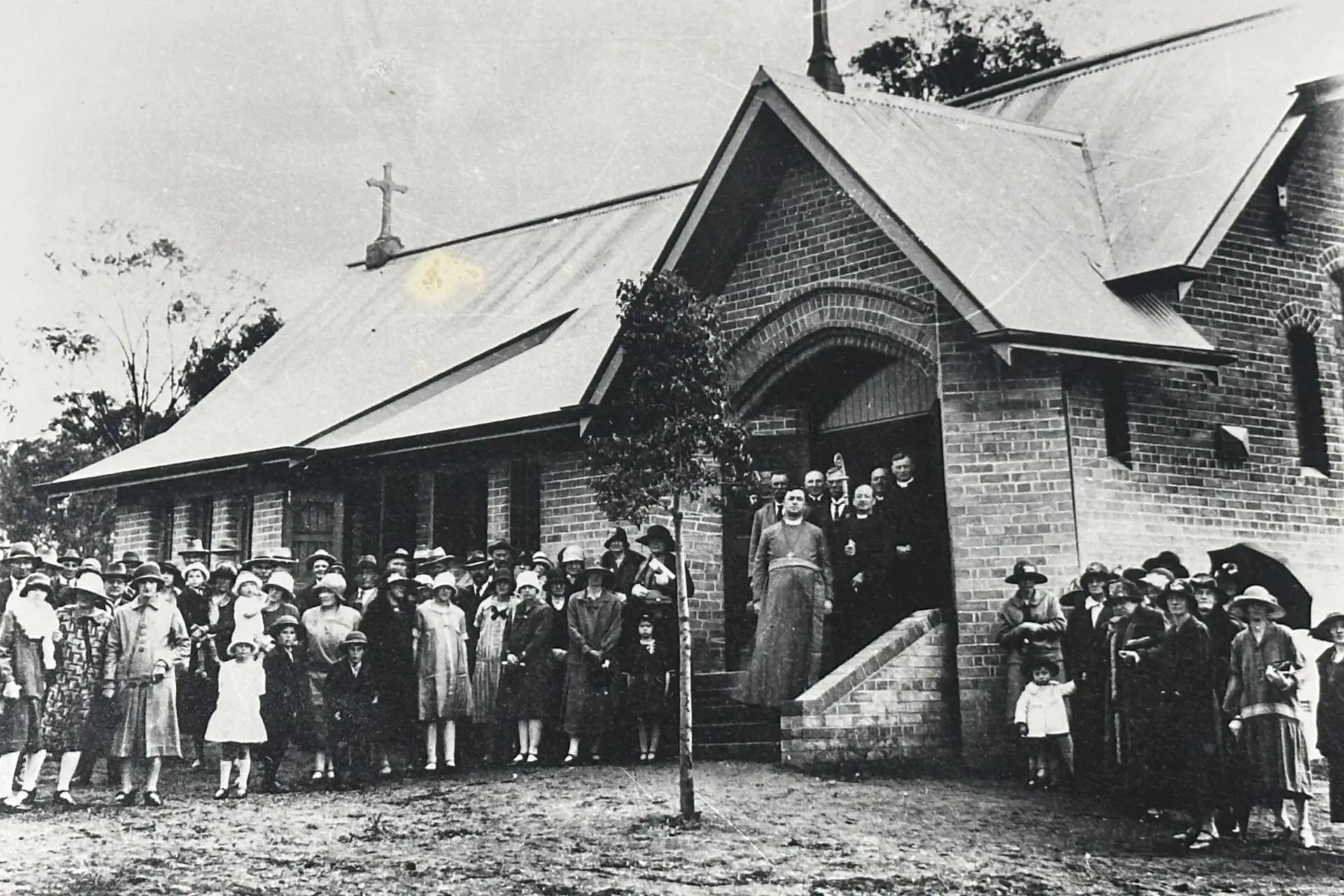
The present church was designed by prominent ecclesiastical architect Louis Williams, with Mr Fletcher undertaking the carpentry and Mr Wilson laying the bricks.
Its construction itself became a community effort.
Edward John Flint made the bricks by hand on site, while local men and boys shovelled and screened sand before transporting it to the church by horse-drawn drays.
Gravel was similarly ploughed out using horses, screened through an old double bed mattress, loaded by shovel onto box wagons and hauled to Morongla.
The foundation stone was laid by Bishop Merrick Long of the Bathurst Diocese on 26 January, 1926, before he returned to consecrate the new St Peter’s on 29 September that year.
The church went on to become the setting for generations of local milestones.
George Baxter and Olive Houghton were the first couple married in the new church in September 1926, while Arthur Charles “Tibby” Flint, the son of the man who made its bricks, was its first child baptised.
For Bob, however, some of the fondest memories came not only from Sunday services, but from the social life that grew around the church.
He particularly remembers the formation of the Young Anglicans in 1949.
“The best part of my church attendance was the forming of the Young Anglicans in 1949,” Bob said.
“The Reverend Canon Harry Thorpe, with the help of John Reeves, curate at the time, formed a branch in Cowra with 120 young people.
“Morongla soon formed a branch.
"We had about 30 members.”
Those groups brought young people from Cowra and Morongla together for dances, tennis and trips, creating friendships and memories extending well beyond Sunday worship.
“At weekends Cowra and Morongla would get together and have dances at Morongla Hall,” Bob said.
“Other weekends we’d get together, play tennis at the back of the church [and] go to Wyangala in groups.
“A good time was had by all.”
The church's historical records similarly recall Morongla's active involvement in the Young Anglican Movement, with meetings, dances and balls held at the hall and tennis tournaments played at the village courts.
Over the decades, St Peter’s has remained closely tied to the families of the district.
Furniture and fittings within the church carry plaques commemorating pioneer families, while many of the trees surrounding the building were planted as memorials to former parishioners.
Bob himself has continued that tradition of service, acting as a church warden for many years and helping maintain the grounds, clear fallen material and prepare the church when required.
Don Langfield has also regularly helped him maintain the churchyard.
St Peter’s has witnessed considerable change in the district during its century, but it has repeatedly brought former parishioners and families back together.
Its 50th anniversary was celebrated in 1976, its 60th in 1986 and its 75th in 2001, with former clergy returning for services and community lunches forming part of the celebrations.
Now, 100 years after its foundation stone was laid and the present building opened, another generation will have the opportunity to gather at St Peter’s and celebrate the role the small country church has played in Morongla.