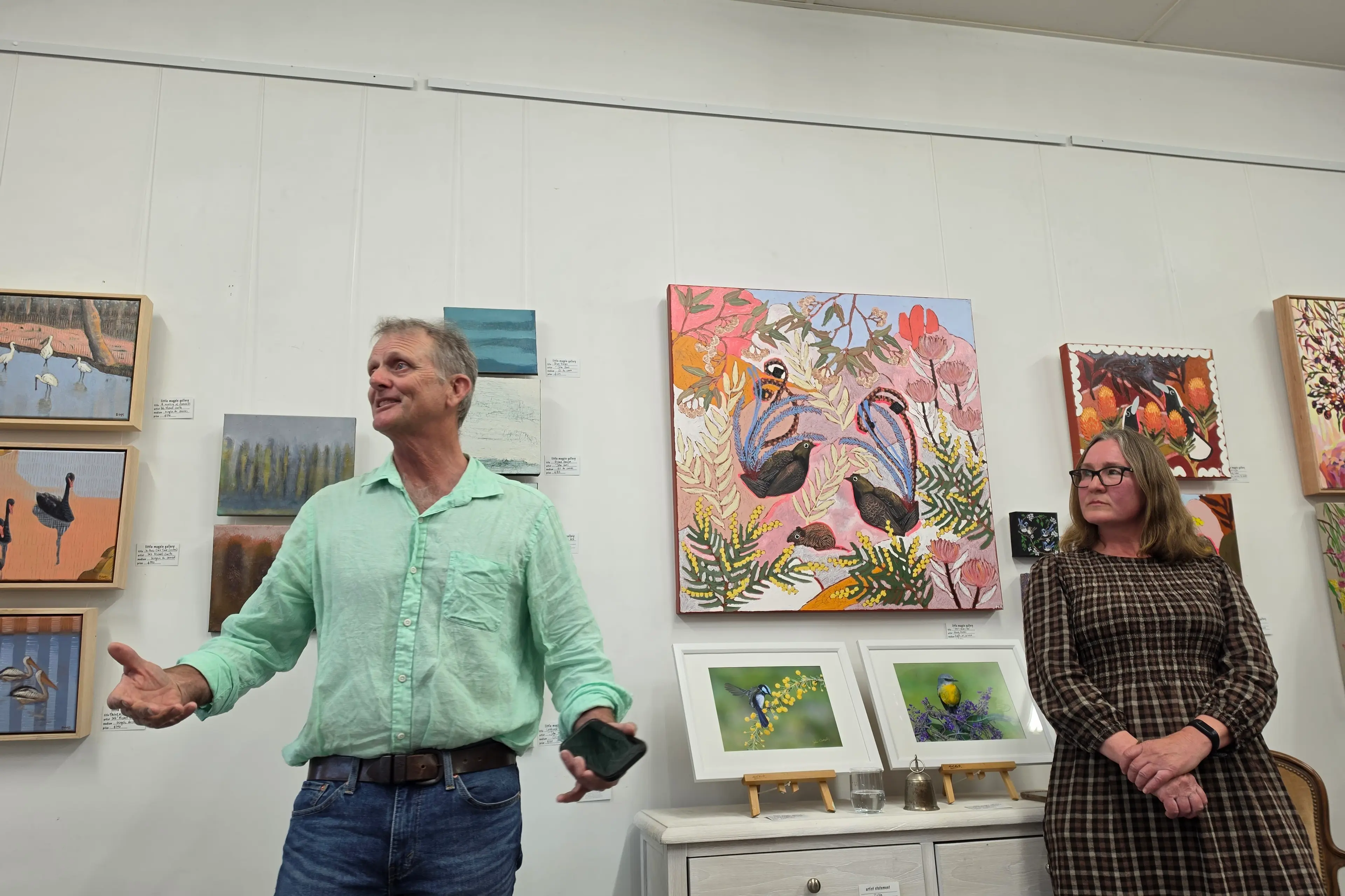
A diverse collection of artists is exploring the connection between people and the natural environment in “Land.Care”, an exhibition celebrating the Australian landscape and those working to protect it. Bringing together art, science and agriculture, the exhibition, curated by Indel Date at Little Magpie Gallery, encourages visitors to consider their relationship with the land and the importance of protecting it for future generations. The exhibition was officially opened by Mid Lachlan Landcare representatives Amanda Foxon-Hill and Scott Hickman, who shared their perspectives on environmental care. Landcare Coordinator Ms Foxon-Hill discussed the relationship between art and science, explaining how both disciplines influence people's understanding of the world. She said art could be a powerful communication and education tool, helping people explore their identities, build connections and consider environmental issues from different perspectives. “Landcare uses art and science as tools,” she said. While science allows people to identify patterns, conduct experiments and make informed decisions, art provides another way to explore complex issues and encourage different ways of thinking. Ms Foxon-Hill said Mid Lachlan Landcare aimed to create opportunities for people to consider their own responses to environmental challenges rather than promote a single perspective. Also speaking was farmer Scott Hickman, team leader of Mid Lachlan Landcare's 'Growing the Grazing Revolution' program. Mr Hickman and his wife, Annie, have farmed for 36 years, practising holistic management that considers the relationship between ecology, animals, people and profitability. For Mr Hickman, leaving the landscape in better condition for future generations remains a central priority. “If we don't have strong farming communities, strong landscapes and communities die,” he said. He explained that farming decisions often have long-term consequences, with practices such as overgrazing potentially affecting land conditions months later. His approach focuses on maintaining ground cover, improving soil health, encouraging biodiversity and adapting to changing climatic conditions. Healthy soil helps retain moisture, supports plant growth and strengthens the landscape's ability to withstand environmental pressures. “Dig up the soil, have a smell of it,” Mr Hickman said. “It should smell alive.” Biodiversity also plays an important role in his farming philosophy. Mr Hickman described the satisfaction of seeing native wildlife return to the property, including superb parrots and wedge-tailed eagles. These encounters demonstrate the importance of maintaining habitats that support both agricultural production and wildlife. He also challenged the idea that humans exist separately from the natural environment. “We are part of nature,” he said. Mr Hickman explained that everyday decisions, from what people produce to what they discard, have environmental consequences. He also highlighted the role livestock can play in regenerating landscapes when grazing is managed appropriately. Rather than simply sustaining agricultural land, he believes actively regenerating it should become a greater priority. The exhibition brings together different perspectives united by a shared responsibility for environmental care. While artists interpret the landscape through creative expression, farmers and Landcare practitioners work directly with it, drawing on experience, observation and science. Through “Land.Care”, visitors are encouraged to consider both the beauty of the Australian landscape and their responsibility in protecting it. The exhibition is on display at Little Magpie Gallery, featuring works exploring people's connections with the natural environment.