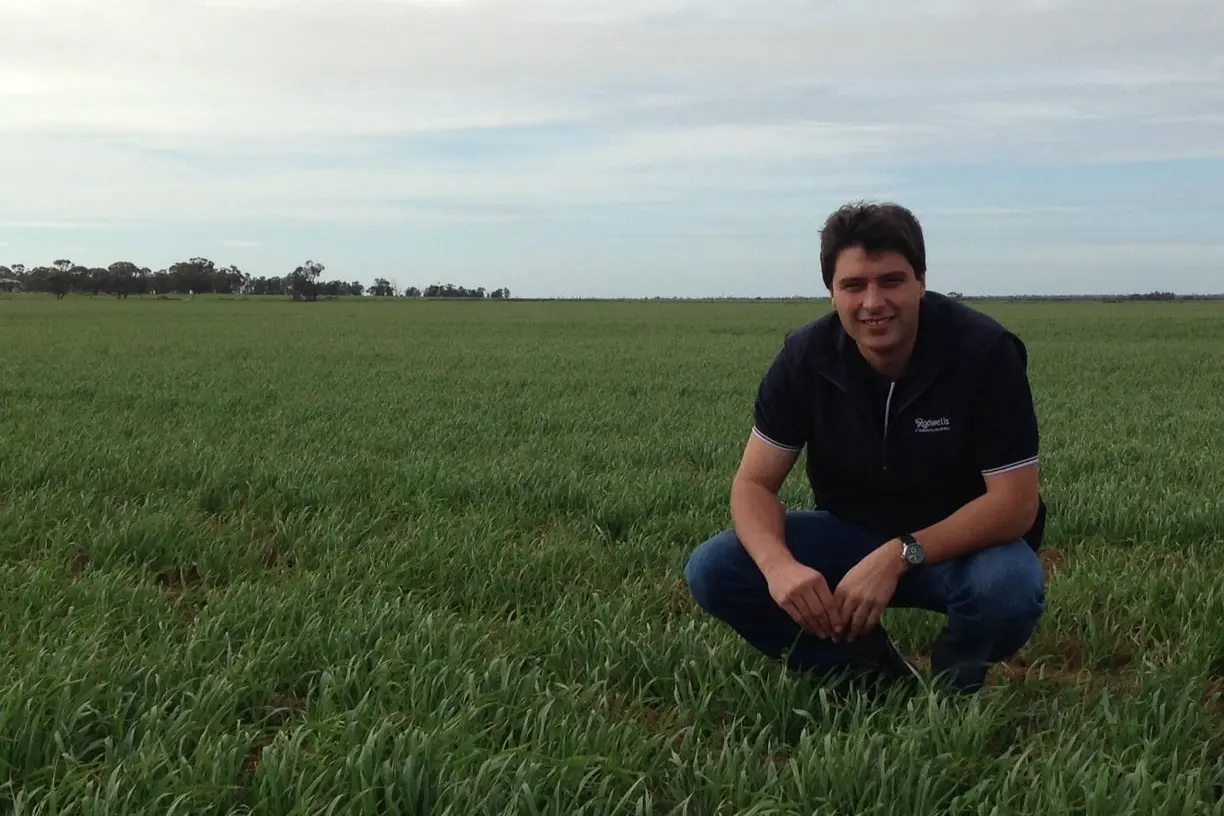
Cowra and Canowindra farmers are being encouraged to review their feed reserves and prepare alternative cropping plans amid concerns that hotter, drier conditions could affect livestock production and next year's winter cropping program. While the district has benefited from relatively well-timed rainfall throughout the growing season, senior agronomist Benjamin Romeo has warned that prolonged dry weather could quickly change the outlook for local agricultural producers. With summer approaching, farmers face uncertainty over pasture availability, soil moisture and the potential impact of seasonal conditions on planting decisions in 2027. Mr Romeo said the Cowra district had been relatively fortunate compared with other parts of NSW, despite rainfall being slightly below average. "We're in a very good little pocket of the state," Mr Romeo said. "We are below average rainfall. "We're only just slightly below average rainfall, but it's fallen at the right times." El Niño is a climate pattern associated with changes in Pacific Ocean temperatures and atmospheric circulation that can influence rainfall and temperatures across Australia. Although El Niño conditions can increase the likelihood of hotter and drier weather in parts of eastern Australia, they do not automatically result in drought. Mr Romeo said the greatest concern for local producers was the possibility of sustained heat and limited rainfall reducing available feed while preventing soil moisture from building ahead of next year's winter cropping season. "We will be chewing into our feed reserves with it," he said. "We're not building some profile for next year, for next year's winter crop." For cropping operations, the amount of moisture stored in the soil before sowing can significantly influence planting decisions. Mr Romeo said canola would be among the first crops reconsidered if sufficient soil moisture was unavailable. "The first ones to go are the canolas if we don't have enough moisture," he said. "If we don't have enough stored moisture to sow it, unless we get a good break." He explained that substantial rainfall before sowing could change the situation, but producers needed to prepare for the possibility of entering autumn with limited stored moisture. "If we do get a good break, it's a different conversation," he said. "But if we don't, the contingency plans are that the canola hectares will reduce or be pulled completely out of the program." Pulse crops could also be affected, with farmers potentially switching to cereal crops if conditions were unsuitable. "Then it moves to pulse crops, whether or not we have enough moisture," Mr Romeo said. "We pull them out, and then we default back to sort of a wheat, barley, oat." He said the choice between long-season and shorter-season cereal varieties would also depend on rainfall and available soil moisture. Farmers may need to reconsider how much long-season wheat they plant, potentially favouring shorter-season wheat or barley varieties better suited to a drier start. Those decisions would also be influenced by the cost of establishing crops. Mr Romeo said fertiliser prices remained a concern, particularly for monoammonium phosphate, commonly known as MAP, which is widely used during sowing. "All indications are fertiliser, like sowing fertiliser, like MAP, is going to be high," he said. "That will influence how much crop goes in, what sort of types of crops go in." The combination of potentially expensive inputs and uncertain seasonal conditions could influence how producers approach their planting programs. However, the possible impacts extend beyond cropping operations. Livestock producers could also face difficult decisions if a hot, dry summer reduces standing feed and limits pasture growth heading into autumn. Mr Romeo encouraged farmers to begin assessing their existing fodder reserves and calculating whether they have enough feed to maintain current livestock numbers if conditions deteriorate. "Preparing now is making sure we've got enough feed reserves with the stock we have on hand," he said. "It's just assessing what feed we have on hand." He said producers should consider whether purchasing additional hay for storage would be necessary. "Do we go and buy hay for storage, or can we get it? Do the math on what we need," he said. The availability of feed during February, March and April could also influence decisions about livestock purchases and sales. Mr Romeo said reduced early fodder growth could force producers to reconsider whether they had sufficient resources to maintain their existing herds or flocks. "That will also influence what stock people are either buying or they're going to sell or what they're going to keep," he said. "And that relies on what fodder reserves they do have." Despite the concerns, Mr Romeo said current pasture conditions across parts of the Cowra district remained relatively favourable. "We're looking at good pastures producing. We've got feed," he said. He noted that mild temperatures had helped preserve standing feed, but warned that conditions could change relatively quickly once sustained summer heat arrived. "We haven't really had the heat to really knock off the feed, to burn it off," he said. "Once we burn it off and we burn through what standing feed we have, well, then it just all flows on." Mr Romeo said the duration of any hot, dry period would be particularly important in determining the severity of the impacts. A short period of dry weather followed by January rainfall could be manageable for many producers, while continued dry conditions through January and February could create greater difficulties. "If it comes hot, dry for a month, and then starts raining in January, well, we're going to hold for about four weeks," he said. However, he warned that an extended dry period could affect both livestock feed supplies and cropping preparations. "If it continues on into our traditional warmer months of January and February, that can have a big impact on standing feed going into next year, plus the ability to actually sow early crops," he said. Dry conditions could also complicate paddock preparation, including incorporating lime into soils and undertaking strategic tillage. Mr Romeo said farmers needed to consider these operational challenges alongside the broader risks to cropping and livestock production. With seasonal conditions remaining uncertain, he emphasised that there was no single approach suitable for every agricultural enterprise. The level of risk would depend on factors including existing soil moisture, stored fodder, livestock numbers and the capacity of individual businesses to withstand an extended dry period. Mr Romeo recommended developing several cropping scenarios, ranging from a full planting program under favourable moisture conditions to reduced or alternative programs if rainfall remained limited. "At the end of the day, it's a moving target," he said. "It comes down to every individual farming enterprise, what they've got on hand, and what their ability is to weather these El Niños and drier summers in regards to fodder reserves for both sheep and cattle." He said producers should approach next year's cropping program with multiple options rather than committing to a single plan before seasonal conditions became clearer. "Have plan As and plan Bs going into cropping next year," he said.