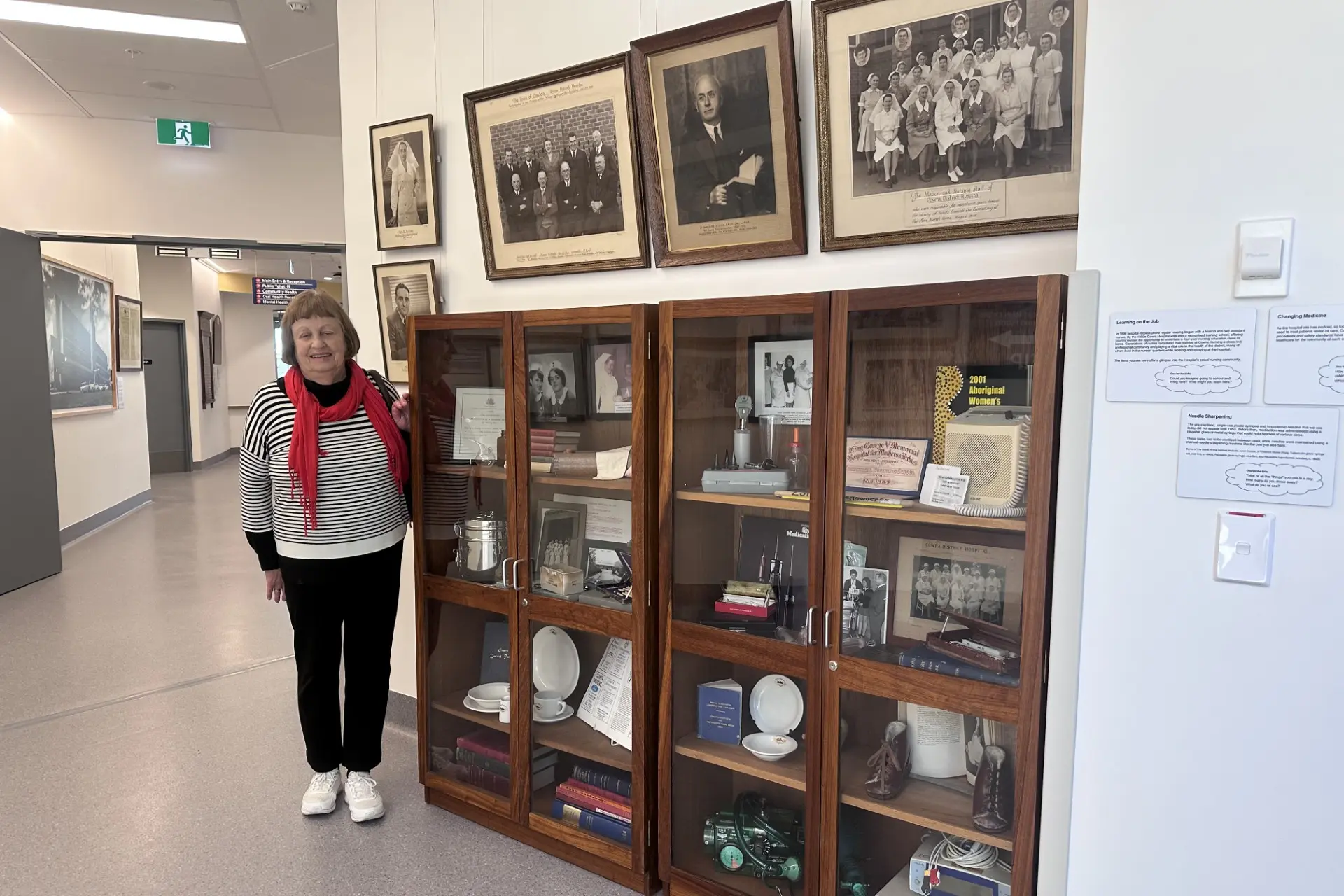
Generations of nursing history have been given a permanent place inside the new Cowra Hospital, with former nurse Carole Doyle helping preserve the equipment, photographs and stories of an era when nurses trained within hospital walls. The historical display forms part of the art and heritage collection incorporated into the $114.3 million Cowra Hospital Redevelopment, alongside more than 30 newly commissioned artworks. Ms Doyle began her nursing training at Cowra Hospital in 1959, completed her training in the early 1960s and eventually returned after leaving to have a family. "I came back and continued to work for 45 years," Ms Doyle said. Her extensive knowledge of the hospital's people, practices and equipment helped guide what was preserved. "Some of the equipment that's displayed here, I understood what was important to go into the cabinet," she said. The collection includes nursing equipment, reference books, sterilising equipment, a life support machine, an early fetal monitor, uniforms and photographs documenting training and graduation. For Ms Doyle, preserving those items is particularly important because they reflect a nursing education system very different from today's university-based pathway. "It's very important because the history of nursing before it went into universities, they trained in hospitals," she said. "All of this is so important, the equipment, the students themselves and their uniform, the encyclopedic books that they used." Nursing training was a four year course combining theory with practical hospital experience. Photographs show students wearing caps marked with stars, indicating their progress through training. The collection also captures changes in patient treatment and hospital operations. Ms Doyle recalled private and intermediate patients receiving china and silverware, while public patients used plainer crockery. As those distinctions disappeared, Cowra Hospital introduced crockery bearing its own badge around the late 1970s. Medical equipment similarly provides insight into changing healthcare practices. One photograph shows specialists Gary Scarp and Warren Wiley, Director of Nursing Pat Walsh and high school students Roslyn Riley and John Bailey presenting a Boyle's machine. Ms Doyle identified it as the hospital's first anaesthetic machine, introduced after earlier anaesthetic practices were discontinued. Other photographs preserve significant moments from Cowra's maternity history, including an image connected to what was then the smallest baby born at the hospital. The baby weighed just 800 grams and remained at Cowra Hospital for three months. "She survived," Ms Doyle said. Long hospital stays were more common then, with some patients remaining for up to six months while recovering. The nursing collection forms part of a broader effort to preserve the hospital's history throughout the redevelopment. Volunteers and the Cowra and District Historical Society contributed to preserving its heritage, including conserving and digitising the original 1884 hospital Land Grant. A replica is displayed alongside historical photographs and other items. The hospital's history has also been paired with contemporary Cowra stories through more than 30 paintings, photographs, collages and sculptures created by artists with local connections. For Ms Doyle, the nursing cabinet ensures generations of nurses who trained, worked and cared for patients at Cowra Hospital remain part of its future.