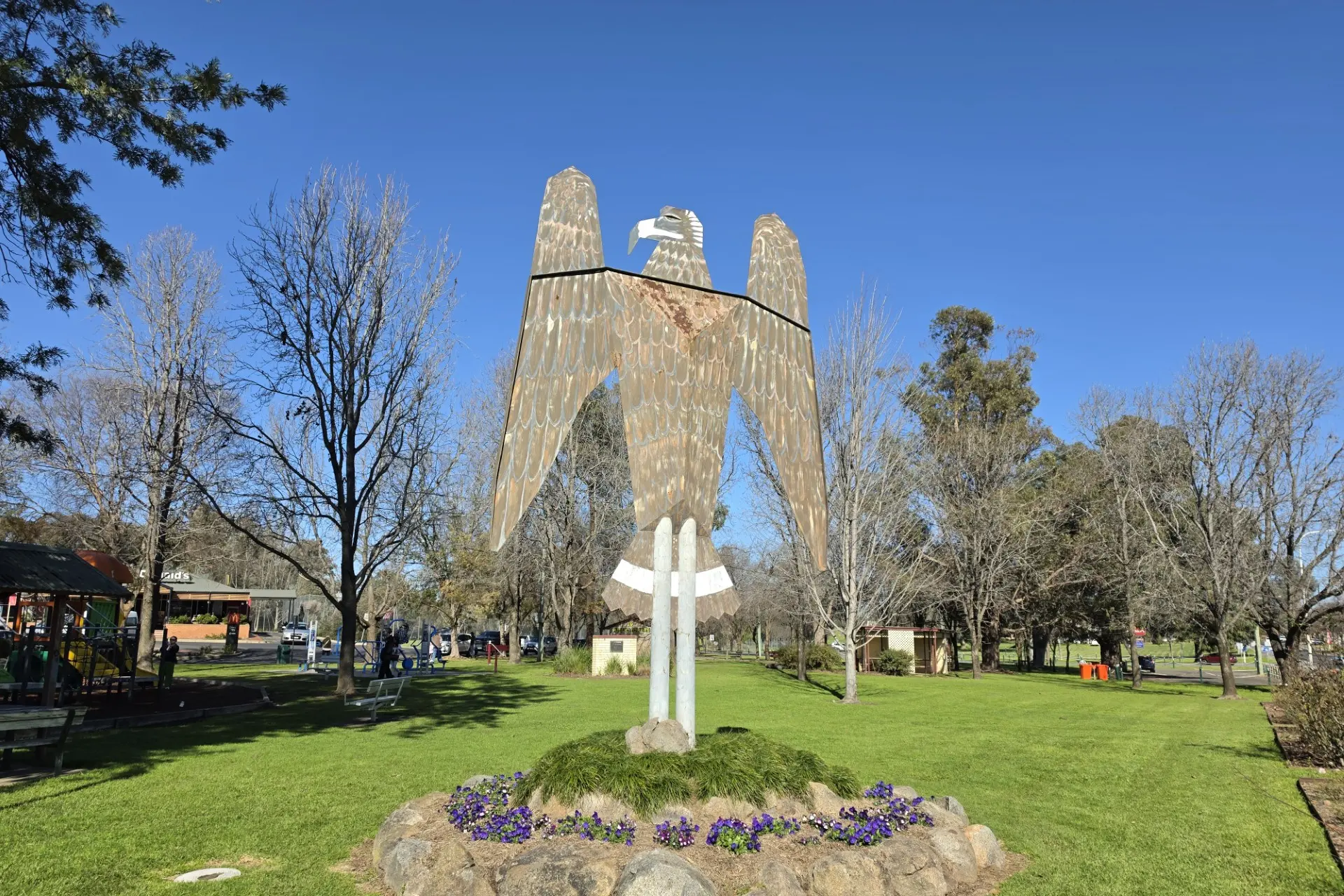
A written statement by the late Don Kibbler, a record held within Cowra and District Historical Society archives, sheds light on the origins of one of the town's most recognisable public artworks, the steel eagle that stands outside the Cowra Visitor Information Centre.

Recently in an online group, a photo of the artwork was shared into a ‘Big Things Australia’ group with the caption, ’Big Hawk in Cowra’.

This misidentification prompted an investigation into the public artwork’s history with a visit to the local Cowra & District Historical Society.

Dated 7 October 2015, the signed statement details Kibbler's account of how the sculpture came to be, explaining that the project began in 1972 after Cowra Chamber of Commerce members Gordon Austin and Grahame Drew approached him with a proposal to create a large eagle for the junction of Boorowa Road and the Olympic Way.

According to the statement, the Chamber had $496 remaining in its account and asked whether he could create the landmark.

Kibbler spent several weeks developing the concept before asking Colin Cranny of Lachlan Steel to build a model based on his design.

Following discussions with Austin and Drew, the project was approved.

The letter reveals the creative thinking behind the sculpture's distinctive appearance.

Kibbler wrote that one of the biggest challenges was giving the steel eagle a sense of body depth.

Inspiration came from an unlikely source, the folded back of an old envelope, which influenced the folded form of the eagle's body.

The statement described how the eagle's legs were made using two donated bore casings from local Irish water driller Dick Murney, who provided the steel free of charge.

As construction progressed, Gordon Austin suggested the eagle needed broader shoulders.

Although initially reluctant to alter the design, Kibbler agreed, and Colin Cranny fabricated additional shoulder sections and reinforced the wings to withstand strong winds.

Once completed, the sculpture was painted by Peter Slattery at his Macquarie Street workshop before being installed on what is now the site of the Cowra Visitor Information Centre.

The statement explained that the original installation was carefully designed, with rocks placed around the base to conceal much of the eagle's legs, creating the impression that the bird was perched naturally on rocky ground.

However, Mr Kibbler claimed that when the sculpture was relocated in 1987 to make way for the Visitor Information Centre, the original design intent was lost.

“Whoever was in charge did not use sufficient quantity of rocks and now it looks nothing of its original design and frankly unbalanced," Kibbler wrote in the letter.

This archived historical document offers a valuable firsthand insight into the collaboration, ingenuity and community spirit behind one of Cowra's enduring landmarks, while also preserving the designer's own perspective on how the sculpture was conceived and how he believed it was meant to be displayed.

The written statement by Mr Kibbler poses an interesting question about what happens to a public artwork when it is relocated from its intended location.

The relocation of the work thirty-nine years has resulted in the eagle having extra-long steel legs above a garden rather than the intended rocks which connect the Wiradjuri meaning of Cowra as rock.

Perhaps the opportunity to refresh the sculpture, in its current location, with relevant stakeholders is needed to ensure the artwork’s original intention is honoured.