
PHOTO
75614.0
Strong sheep and lamb prices have continued at the Cowra Regional Livestock Selling Centre, with old lambs reaching an impressive $429.20 a head at the 26 August sale as quality local stock continues to attract strong competition.
The near record result capped off several weeks of solid prices at the Cowra yards, where producers have benefited from strong demand across both old and new season lamb categories.
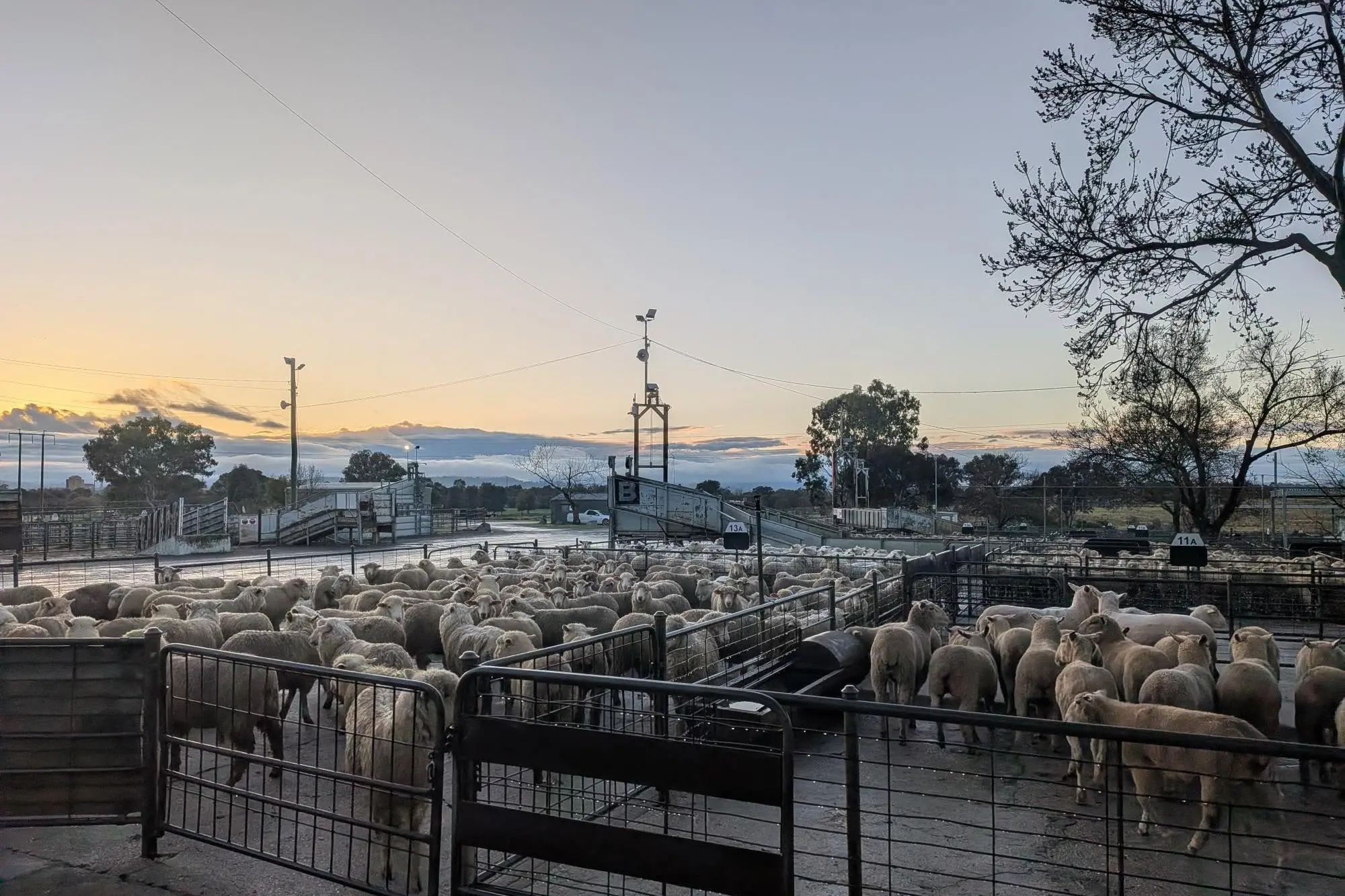
The 26 August sale saw 3,225 sheep yarded, including 2,900 lambs and 325 grown sheep.
Of the lamb offering, 1,170 were young lambs and 1,730 were old lambs, reflecting the gradual seasonal transition now taking place as spring approaches and more new season lambs begin entering the market.
The $429.20 top price for old lambs was another standout result for Cowra and reinforced the strength of the market for well finished, heavy livestock.
Stock and Station Agent Jack Harper said quality remained one of the biggest factors determining returns, particularly as the old lamb season begins to wind down.
“Most of the old lambs now are falling into the export or heavy trade category, and if in good condition, are still providing magnificent returns,” Mr Harper said in his July market update.
However, the difference between well finished lambs and those beginning to show the effects of winter has become increasingly pronounced.
“Lambs not carrying cover or those beginning to look wintered have taken the biggest hit,” Mr Harper said.
The 26 August result continued a run of strong prices recorded through Cowra during winter.
Heavy lambs reached as high as $430 at the 8 July sale, while merino ewe lambs sold to $220.
A week later, lambs reached $368 at the 15 July sale, with the top priced offering sold by vendor Scott McNanus.
Grown sheep also performed strongly at that sale, reaching $330, with those sheep sold by Scott Selmes.
New season lambs then reached $313 at the 29 July sale as the first significant signs of the new lamb crop began appearing through the Cowra market.
Mr Harper said the arrival of those new season lambs, or suckers, was one of the most anticipated periods of the sheep selling calendar.
“As winter nears a close, the number of old lambs does begin to dwindle, and the suckers take over the yarding,” he said.
“Whilst yet to come in huge numbers, we have begun to see the first of the new season lambs dribble through the market in Cowra.”
For Mr Harper, the shift brings a noticeable change to the yards.
“There’s a huge excitement, at least for me, when the fresh, prime suckers are lined up, pen after pen, in the market,” he said.
The early sucker market has already produced strong returns.
Mr Harper said heavy trade new-season lambs were sitting around 1260 cents per kilogram in mid-July, while lighter trade lambs in the 21 to 23 kilogram range were approaching $13 per kilogram.
As greater numbers entered the market, prices eased slightly but remained strong.
“As the numbers increased through the weeks, the market found an ever so slight correction and settled around 1230c/kg,” Mr Harper said.
“I would expect that to again find a more balanced average as the weeks roll on through August and early September.”
For producers able to have early drafts ready for sale, the returns have been particularly rewarding.
“For now, though, it is a great reward for those producers who have early drafts of suckers to turn off,” he said.
The strong prices have come during considerable fluctuations in weekly numbers at the Cowra Regional Livestock Selling Centre.
A total of 2,770 sheep were yarded on 15 July, including 2,320 lambs and 450 grown sheep.
By 12 August, the scheduled offering had increased to 3,090 head, made up of 2,720 lambs and 370 grown sheep.
Of those lambs, 770 were new season lambs and 1,950 were old lambs.
The following week saw a substantial increase, with the 19 August sale attracting a total yarding of 5,060 sheep.
That offering included 3,750 lambs and 1,310 grown sheep.
Of the lambs, 1,100 were classified as young lambs while 2,650 remained old lambs.
Allan Gray & Co was allocated 2,600 lambs for the 19 August sale, including 1,100 young lambs and 1,500 old lambs, as well as 900 grown sheep.
JJ Dresser & Co was scheduled to offer 1,100 old lambs and 300 grown sheep, while MCCHO had 50 old lambs and 110 grown sheep.
By 26 August, the yarding had eased back to 3,225 head.
Allan Gray & Co was again scheduled to present the largest offering, with 700 young lambs and 1,100 old lambs for a total of 1,800 lambs, together with 200 grown sheep.
JJ Dresser & Co was allocated 220 young lambs, 370 old lambs and 100 grown sheep, while MCCHO was scheduled to offer 250 young lambs, 260 old lambs and 25 grown sheep.
The changing balance between old and young lambs is expected to become increasingly noticeable as spring progresses.
While the arrival of new season lambs is gathering momentum, Mr Harper said the expected disappearance of old lambs from the market had not occurred as dramatically as some anticipated.
“Quite often, the chatter at this time of the year is that the lambs will run out,” he said.
“Once again, the lambs never really did.”
While numbers may not be as high as in some previous seasons, he said old lambs remained available across markets throughout NSW.
However, many of those older lambs are now moving into heavier categories or beginning to break their two teeth and be classified as hoggets.
“As a result, they are very much being pushed out the gate to make room for the new seasons,” Mr Harper said.
Grown sheep have also contributed to the strength of recent Cowra sales.
Mr Harper said mutton prices surged early in July, with cull sheep reaching more than $10 per kilogram.
“Mutton had its moment in the spotlight early in July with cull sheep reaching over $10/kg,” he said.
“Lighter and trade sheep seemed the dearest through this period to me.”
However, he believed that level of pricing was unlikely to be sustained indefinitely.
“This to me was rather unsustainable,” Mr Harper said.
“It has since had a price correction but is still hovering close to $8.”
Despite that correction, grown sheep prices at Cowra have continued to produce strong headline results, including the $330 top price recorded on 15 July.
The strength of the livestock market has been supported by favourable seasonal conditions across much of the district.
Mr Harper said July had been noticeably drier than the months preceding it, although moisture remained visible across parts of the Lachlan Valley.
“In some areas you certainly wouldn’t think so with how the water still lazily lays in wheel tracks through crop paddocks spotted throughout the Lachlan Valley,” he said.
The drier weather was accompanied by several frosts towards the end of the month.
Mr Harper said the frosts may not have been exceptional by historical standards but had felt particularly cold because of their relatively late arrival.
The broader seasonal conditions, however, have helped livestock continue to develop.
“As for July as a whole, I think we are in a great position all round,” he said.
“The weather has been more than kind, and the stock is jumping ahead.
“It really has been a perfect recipe.”
That combination of quality livestock, favourable seasonal conditions and continued buyer competition has helped Cowra produce a series of strong sale results.
The recent market has also reinforced the importance of presenting stock in the right condition.
Heavy, well finished lambs have continued to command premium prices, while lighter or winter affected stock has experienced more pressure.
That divide is likely to remain important as producers make decisions about when to market remaining old lambs and when new-season drafts are ready to come forward.
For Cowra producers, the recent run of prices has provided several significant results.
From heavy lambs reaching $430 on 8 July, to $368 on 15 July, new season lambs reaching $313 later that month and old lambs returning $429.20 on 26 August, the local market has continued to offer strong returns for quality livestock.
The near record 26 August price provides another indication that buyers remain prepared to compete strongly when high quality lambs are presented.
As spring arrives, attention will increasingly shift towards new season lambs, with the number of suckers expected to grow while the remaining old lambs gradually move out of the system.
For Mr Harper, that transition marks one of the most exciting periods of the livestock calendar.
“Suckers into stud season really is my favourite time of year on the sheep selling calendar,” he said.
“Never a dull moment, a breath of fresh air and new life through the yards, ram sale catch ups, and spring knocking on our door.”
With Cowra produced lambs continuing to attract premium prices and spring supply beginning to build, the Regional Livestock Selling Centre is likely to remain closely watched by producers as the market enters the next stage of the season.