
PHOTO
79305.0
For most residents, a cracked or uneven footpath might mean watching their step.
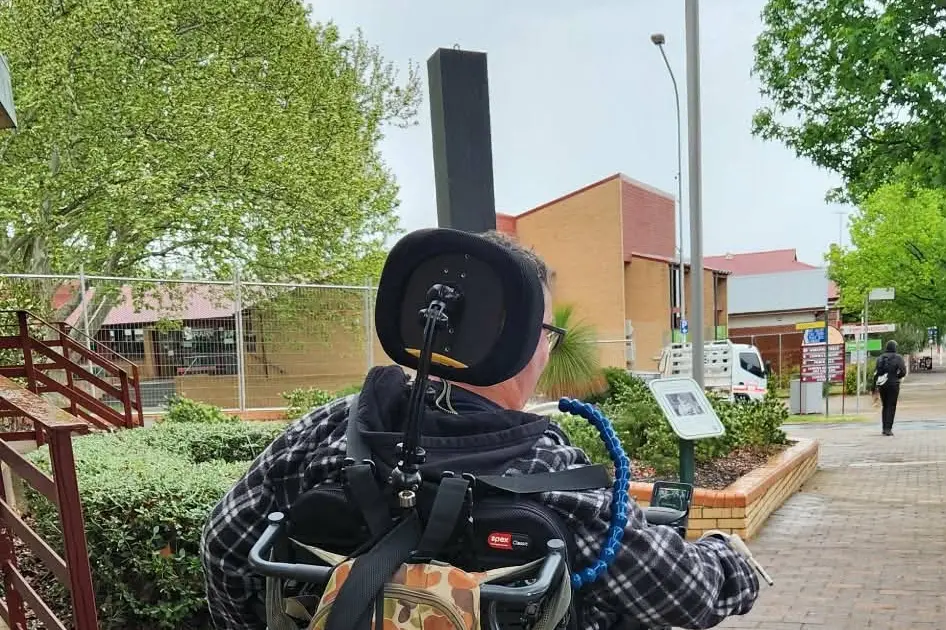
For Cowra wheelchair user Richard Kemp, it can mean abandoning the footpath altogether and travelling beside moving traffic in gutters and bike lanes.
Despite accessibility concerns being repeatedly raised with Cowra Shire Council and its Access Committee, deteriorating footpaths, uneven pavers and inadequate accessible parking continue to restrict how some residents can move independently through their own town.
Mr Kemp, who is a quadriplegic, says the problem becomes particularly apparent outside the upgraded section of Cowra's CBD.
“The main street between Lachlan and Brisbane streets is good, but there are still businesses that are not accessible,” Mr Kemp said.
“The footpaths between Brisbane Street and beyond Darling Street are uneven trip hazards.”
But for Mr Kemp, the issue goes considerably further than discomfort or inconvenience.
The repeated movement caused by his wheelchair travelling across rough and uneven surfaces can trigger physical spasms.
Those spasms can then cause his wheelchair to stop suddenly or change direction, including towards the gutter.
“As a wheelchair user, the uneven paving causes spasms, which in turn causes incidents where the wheelchair suddenly stops and/or swerves towards guttering,” he said.
Rather than continue navigating deteriorated pedestrian infrastructure, Mr Kemp said there were parts of Cowra where he instead travels along the road.
“The rest of the town I drive my wheelchair on the edge, in the gutter and bike lanes, because of the rough condition of the footpaths,” he said.
It is a stark consequence of an accessibility problem Council itself acknowledges exists.
Cowra Shire Council confirmed it and its Access Committee had received feedback about numerous accessibility issues throughout the CBD, including uneven footpaths, pavers raised by tree roots, debris, the gradient of Kendal Street and some corner approaches.
“These issues can affect people in different ways depending on their mobility needs, particularly wheelchair and mobility scooter users, people using walking aids and elderly members of the community,” a Council spokesperson said.
Council also acknowledged infrastructure that may appear adequate to one resident can create a significant barrier for another.
“Different modes of mobility can require different standards and conditions for safe and comfortable access,” the spokesperson said.
“Council recognises that an area that may be relatively easy for one person to navigate can present a significant challenge for someone else.”
For Mr Kemp, that challenge is not confined to footpaths.
The availability and size of accessible parking spaces also affects his ability to independently access parts of Cowra.
Asked about other barriers he regularly encounters, Mr Kemp pointed to “no accessible parking or no spaces large enough for accessible parking”.
Council confirmed accessible parking was among concerns raised by the community and said identified accessible spaces within the CBD, including existing line marking, had been reviewed.
But Mr Kemp believes piecemeal repairs are no longer enough.
“Upgrade footpaths, not just repairing,” he said.
“Make available accessible parking bigger."
Council said staff regularly inspect CBD footpaths and pavers for uneven surfaces and potential trip hazards, with maintenance including replacing pavers, concrete grinding, replacing uneven concrete panels and replacing tactile indicators where required.
Recent improvement works have been undertaken around the Council and Cowra Peace Bell precinct, with further works planned along Vaux Street.
According to Council, projects are prioritised according to identified risk, infrastructure condition, available funding, resources and broader works programs.
Community feedback and concerns raised through the Access Committee can also influence future priorities.
Council said the age of Cowra's infrastructure added another challenge.
“Much of Cowra’s CBD was established at a time when accessibility and design standards were different to those in place today,” the spokesperson said.
“Existing infrastructure, building design and available funding can all present challenges when retrofitting older areas.”
However, the consequences of that ageing infrastructure are being experienced now.
Council's Disability Inclusion Action Plan covers 2025 to 2029 and includes actions intended to reduce barriers and improve inclusion, while its Access Incentive Scheme offers eligible businesses, organisations and service providers grants of up to $10,000 for accessibility improvements.
The grant can assist with measures including ramps, automated doors, widened doorways, handrails, tactile indicators and signage.
Yet those improvements address only part of the journey if residents face barriers simply getting to the door.
For Mr Kemp, the condition of the public infrastructure connecting homes, businesses and services remains fundamental to independence.
He believes many of the physical problems are visible even to people who do not use a wheelchair.
“Generally yes,” he said when asked whether other residents would notice the issues.
“The main issue is most people only worry about issues that affect themselves.”
Council similarly acknowledged that understanding accessibility requires listening to those who encounter barriers firsthand.
“People experience disability and accessibility differently, and a barrier that may not be apparent to one person can significantly affect another person’s ability to move through the community independently,” the spokesperson said.
“Feedback directly from people with disability helps Council better understand how infrastructure works in practice, not simply how it appears on paper.”
Council said accessibility remained an ongoing process and encouraged residents to continue reporting barriers directly or through its Access Committee.
“Council will continue working with people with disability, the wider community and the Access Committee to identify practical improvements that help make Cowra more accessible for everyone.”
For Mr Kemp, however, accessibility is not an abstract planning objective.
It is the difference between using a footpath and travelling along the edge of the road just to move around his own town.