
PHOTO
77588.0
A small ceramic filtration unit processing just 300 litres of water an hour could help determine how Cowra treats millions of litres of drinking water each day in the decades ahead.
Cowra is preparing for a proposed 12-month trial of ceramic membrane technology at its Water Treatment Plant, with the emerging system being investigated as a potential alternative to the conventional clarification and filtration processes currently used to treat the town’s water.
While the pilot itself will be small, occupying only around four square metres and treating approximately 7.2 kilolitres each day, the technology could eventually be scaled to form part of a new treatment system capable of processing around 21 megalitres a day.
The trial comes as planning continues for the future of Cowra’s ageing Water Treatment Plant, which is currently listed for replacement around 2030-31.
However, with a conventional replacement estimated by NSW Public Works at about $56 million before substantial site-related costs are considered, investigations are underway into whether newer technologies could offer Cowra another way forward.
NSW Public Works has identified ceramic membrane technology as a potentially advantageous option, particularly because of the limited amount of land available at the existing treatment plant site.
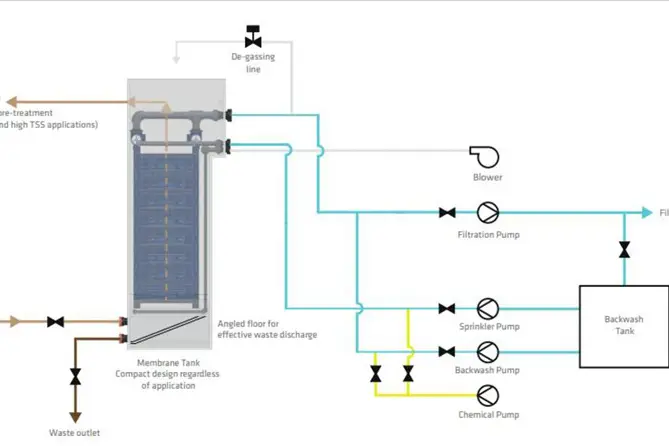
Unlike conventional treatment, ceramic membranes combine elements of the clarification and filtration process through physical separation.
Water is pumped into a feed tank containing submerged membranes. Water molecules are able to pass through tiny pores in the membranes, while suspended solids, pathogens, colloids, algae and other contaminants are retained.
Depending on the membrane pore size, the technology can remove particles ranging from suspended solids through to bacteria and certain viruses.
Ceramic membranes are also considered particularly durable, with individual membranes having an expected asset life of between 10 and 20 years. They are resistant to chemicals and fouling, require a relatively small footprint and can produce consistently high-quality treated water.
The proposed trial would test whether those advantages translate successfully to Cowra, particularly when dealing with raw water drawn from the Lachlan River.
Director of Infrastructure and Operations Dirk Wymer said the variation in the quality of incoming water was one of the key reasons a full year of testing was considered necessary.
“The key to the whole technology is why we’re proposing a 12-month trial,” Mr Wymer said.
“Obviously we get a lot of variation in the quality coming into it, and we need to demonstrate how the technology would be acceptable for extension to a full-scale plant.”
The pilot would operate at approximately 300 litres per hour without interrupting the Water Treatment Plant’s existing operations or drinking water production.
Over the course of the year, its performance would be tested through different seasons and varying Lachlan River water conditions.
Researchers would examine the quality of treated water against Australian Drinking Water Guidelines, how quickly the membranes foul, the cleaning and maintenance they require and their overall reliability.
The trial would also deliberately examine what happens when treatment chemicals are under or overdosed, providing information about how the membranes respond and what effect those changes have on finished water quality.
The ultimate goal is not simply to determine whether the system can clean water, but whether it can do so reliably, efficiently and economically at the scale Cowra requires.
Mr Wymer said the potential footprint of a full-scale system was one of the technology’s most interesting features.
A ceramic membrane component capable of treating around 21 megalitres each day, comparable with the existing plant’s capacity, has been initially estimated to require only about 40 square metres.
That figure does not include other infrastructure such as chemical storage and dosing facilities, waste management or ultraviolet disinfection, but the relatively compact membrane system could prove important on Cowra’s constrained existing site.
“The full-scale plant, 21 megalitres a day, was 40 metres squared footprint for that part of the process of treating, which is very exciting,” Mr Wymer said.
He said the technology also appeared readily scalable, with additional membrane components able to be incorporated into a larger system if the trial proved successful.
The investigation is particularly significant because of the enormous cost associated with Cowra’s longer-term water infrastructure.
Council’s Long-Term Financial Plan currently provides for replacement of the Water Treatment Plant in 2030-31.
Another option under consideration involves approximately $5.7 million in interim upgrades to the existing facility, which could potentially extend its operational life until around 2049-50.
While those works could buy Cowra considerable time, investigations are still required to determine what technology should ultimately replace the existing treatment process.
NSW Public Works has been examining several alternatives, including a high-rate lamella clarifier, the proprietary Actiflo ballasted clarification system and ceramic membrane treatment.
Mr Wymer said the cost of conventional treatment plants was becoming a major consideration.
“The cost of traditional treatment plants is going through [the roof],” he said during discussion of the proposal.
He said Public Works had estimated a new Cowra Water Treatment Plant at “of the order of $56 million”, with additional site requirements potentially pushing the overall project into the vicinity of $80 million to $90 million.
Before any ceramic membrane system could become part of Cowra’s permanent water infrastructure, however, the technology needs to prove itself against local conditions.
The proposed pilot is expected to cost $194,712 excluding GST.
That includes $75,700 for the hire of a fully automated pilot unit for 12 months and $96,302 for NSW Public Works Advisory to supervise and analyse the trial and prepare a detailed evaluation report, with the remaining allocation covering staff time.
The final report would assess everything from seasonal performance and chemical dosing requirements to cleaning effectiveness, water-quality compliance, operational risks and potential capital and operating costs for a future full-scale system.
The trial will depend on funding support from the NSW Government’s Safe and Secure Water Program, with an application lodged seeking 50 per cent of the project's cost.
If successful, the remaining half would be funded from Cowra’s water fund reserve. The proposal will not proceed if the grant application is unsuccessful.
Deputy Mayor Nikki Kiss said Cowra was already well aware of the ageing condition of its existing plant and the need to consider its future.
“Our water treatment plant is aging. We’re acutely aware of that,” Cr Kiss said.
“We currently have it in our long-term financial plan that it needs to be replaced by about 2030-31, but there is a potential option of refurbishing the plant to extend its life and potentially defer replacement.
“The ceramic membrane has been recommended by New South Wales Public Works, so maybe it will be a solution for us.”
Cr Peter Wright said the trial represented an opportunity to investigate a different way of treating Cowra’s water rather than automatically relying on the processes used in the past.
“We’re trying something more innovative in cleaning water than what we’re doing presently,” he said.
“I think it’s something that we’ve got to try and we’ve got to do to look to the future.”
Although the pilot will treat only a tiny fraction of Cowra’s daily water requirements, Cr Wright said the information it generates will be its real value.
“It’s one of those exciting type things where we’re looking for a better way of doing things, and we’re treating the water plant as an asset, not a liability,” he said.
“To do that, you’ve got to spend money to find out a better way of doing it.”
For Cowra residents, there will be no interruption to the existing plant or drinking water production while the pilot operates.
Instead, the small unit will spend a year quietly testing Lachlan River water alongside the existing plant, gathering the information needed to determine whether a technology occupying only a few square metres could eventually play a much larger role in securing Cowra’s future water supply.