
PHOTO
Cowra's spring livestock market has delivered strong returns for sheep producers, with new-season lambs reaching $408 a head during September as buyers competed for quality stock across the Central West.
The standout price was recorded at the Cowra Regional Livestock Selling Centre on 9 September, when lambs reached $408 and sheep sold for up to $354.20.
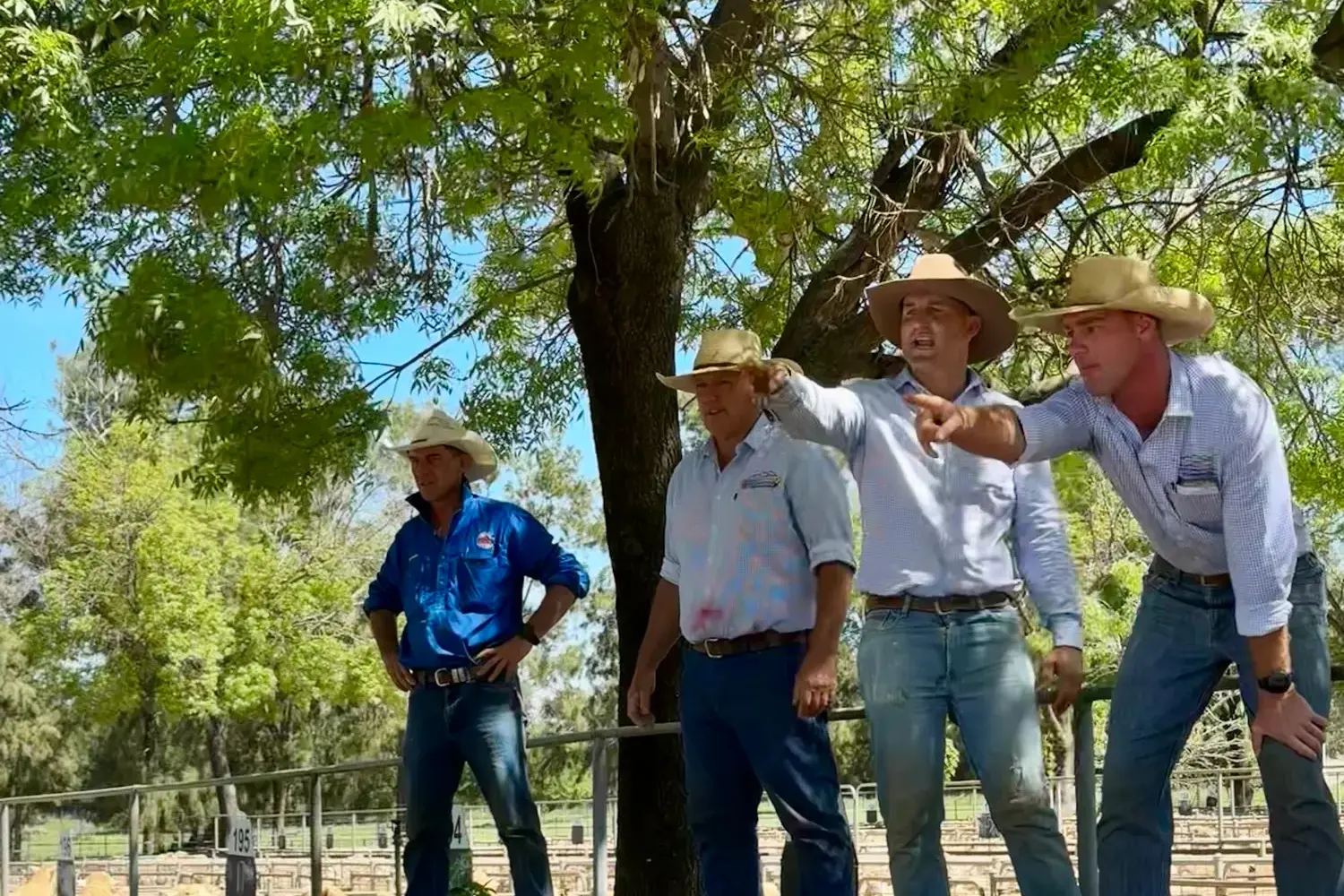
Allan Gray & Co stock and station agent Jack Harper said spring had brought another busy period, with new-season lambs increasingly dominating saleyard numbers.
"Lamb throughput has seen no decline," Mr Harper said.
"Old lambs are essentially done now with the only real old lambs left in runs being tail-end merino lambs.
"New seasons (suckers) have well and truly dominated the yarding numbers."
Cowra recorded 6,860 sheep and lambs on 2 September, including 4,960 lambs and 1,900 grown sheep.
Numbers eased to 4,580 on 9 September before increasing to 5,150 on 16 September.
By 30 September, yardings had climbed to 7,270 head, including 6,750 lambs, of which 5,850 were new-season lambs.
Prices fluctuated throughout the period, with new-season lambs reaching $355 on 2 September before climbing to $408 the following week.
The top price eased to $347 on 16 September and $302 on 23 September, before recovering to $340 on 30 September and $350 by 7 October.
Mr Harper said presentation and condition remained critical to achieving strong returns.
"Suckers that have remained freshest have seen the greatest returns in the market, with those starting to go off seeing slightly less prices," he said.
"This comes down to a few points: presentation and yield."
He explained that many producers had already marketed their earliest-born lambs, while others were preparing for shearing as wool growth increased.
"Once lambs have begun to run to wool, they struggle to present in quite as good condition," he said.
The best-presented lambs were achieving approximately 1080 to 1120 cents per kilogram, compared with 1020 to 1060 cents for those showing heavier wool growth or reduced freshness.
"The lamb market has found a new level," Mr Harper said.
"Competition continues to come from right up and down the Eastern states from processors, feeders, and store buyers."
Seasonal conditions also influenced producer decisions, with early spring warmth and wind initially raising concerns about a dry turn.
However, conditions improved towards September's end.
"Let's just say as the month concluded, we found ourselves in a pretty handy spot," Mr Harper said.
With many lambs now weaned, producers are preparing subsequent drafts for shearing and sale, although lambs generally require four to six weeks to regain condition following shearing.
September also brought strong results for the region's stud sheep industry.
Allan Gray & Co conducted consecutive ram sales, including the Felix Rams sale at Greenethorpe, which achieved a 100 per cent clearance rate, followed by the Goonigal Poll Dorsets sale at Canowindra Showgrounds.
"Seeing our vendors get the results they deserve in both the stud and commercial sections really is still the greatest part of this role in our industry," Mr Harper said.
Meanwhile, cattle markets remained comparatively steady, with lower yardings and subdued feedlot demand.
As producers balance livestock sales, shearing, haymaking and harvest preparations, Mr Harper said spring remained one of agriculture's busiest periods.
"It's hay-making season, almost harvest, shearing, and lamb selling time. It's all happening in this little neck of the woods."