
PHOTO
78253.0
The walls of Cowra’s new hospital may be new, but tucked among its modern corridors are stories stretching back more than 140 years, stories of residents who donated money, supplied goods, raised funds and worked to ensure their community had a hospital at all.
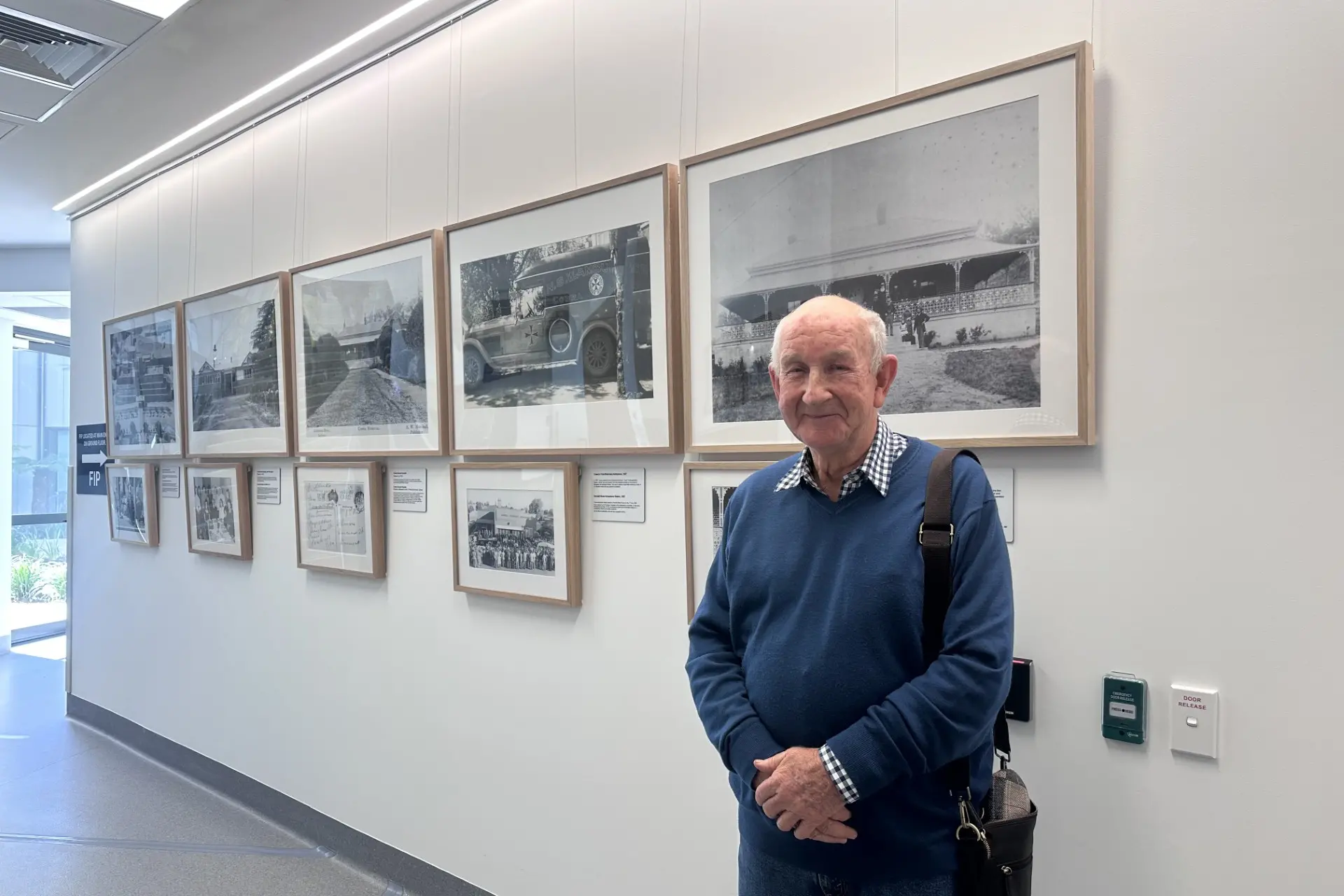
Those stories have been carefully pieced together by the Cowra and District Historical Society, with president Ray Walsh helping sift through hundreds of photographs and historical records to create a display tracing the journey of healthcare in Cowra.
The historical collection now sits alongside more than 30 newly commissioned artworks as part of the $114.3 million Cowra Hospital Redevelopment, ensuring the new facility carries pieces of the hospitals and people that came before it.
For Mr Walsh, preserving that history was particularly important because Cowra’s earliest hospital facilities were built not simply through government investment, but through the determination and generosity of local people.
“I think it was important because so many of them gave a lot of time and money and goods to actually equip that first hospital,” Mr Walsh said.
“It wouldn’t have happened without that.”
At the centre of the historical display is one document which Mr Walsh considers particularly significant, the original land grant associated with establishing a hospital on the current site.
The document dates to 1884 and has now been conserved and digitised, with a replica displayed in the new hospital alongside photographs and other historical material.
“This is probably one of the most important items of them all because this is a land grant,” Mr Walsh said.
“This was a grant that was sought by local townspeople, some prominent people.
"They got the grant.
“[They were] given five acres of land here by the state government.”
The grant paved the way for the first hospital on the current site, which Mr Walsh said was built in 1885.
But receiving the land was only the beginning.
Mr Walsh said government support for establishing and equipping hospitals was very different at the time, leaving the community responsible for finding much of what was needed to make the facility operational.
“There was no really, aside from the grant of land, which didn’t cost them anything, there was no government support for a hospital in those days,” he said.
“It was all privately done.
“So the first hospital on this site would not have happened if it hadn’t been for that grant and then the people who got behind it and built this.”
That community involvement continued long after the hospital first opened.
One of the displays preserved within the new facility recognises people who worked at the hospital or made significant contributions of time, money or goods.
Mr Walsh said looking through the names revealed just how broad that community contribution had been.
“When I went through their names, many of them didn't actually worked here,” he said.
“But a lot of these other people were people who made large donations in time or money or goods to the hospital.
“So it’s very important that we keep that.”
The memorial board covers approximately 1983 to 1988, before the hospital’s rose garden increasingly became the memorial for people associated with the facility.
That rose garden has since been relocated from near the hospital site to the cemetery, continuing its role as a place of remembrance.
However, some of the community contributions preserved through the new historical exhibition reach much further back.
Mr Walsh pointed to local families who helped raise funds and provide items for the hospital, including those who contributed towards furnishing its children’s ward.
“Some of those people on the board, they equipped the children’s ward in that hospital in 1928,” he said.
Their contributions provide a glimpse into a period when supporting a hospital could mean residents personally raising the money needed for furniture, equipment and other necessities.
It is precisely those stories Mr Walsh and the Historical Society wanted to ensure were not lost as Cowra transitioned into its newest hospital.
The task required considerable research.
Historical papers were supplied for the project, while Mr Walsh worked his way through hundreds of photographs before a selection was chosen, framed and arranged to tell the story of healthcare in the town.
“It was really important ... making sure that we recognise the previous hospitals, but this is not a museum in that sense,” Mr Walsh said.
“It was sort of the journey to where we got to.”
The historical display now provides a link between those earlier facilities and the hospital serving Cowra today.
It forms part of a broader art and heritage collection developed for the redevelopment, which combines newly commissioned paintings, photographs, collage and sculpture with works retained from the former hospital.
The collection was developed with support from Arts OutWest, Cowra Regional Art Gallery and The Corridor Project, while volunteers and the Cowra and District Historical Society assisted with the heritage component.
The original 1884 land grant has been conserved and digitised specifically so its story can continue to be shared without placing the historic document itself at unnecessary risk.
For Mr Walsh, its inclusion helps demonstrate just how much Cowra Hospital has always belonged to the community around it.
Long before a $114.3 million redevelopment could be delivered through modern health infrastructure programs, local residents were donating what they could to establish and equip healthcare facilities themselves.
Some gave money.
Others gave goods.
Some volunteered their time.
Generations later, their names, photographs and contributions have been carried into the newest hospital.
The result means that while Cowra has gained a modern healthcare facility, the community members who helped build the hospitals that came before it have not disappeared with the old buildings.
Their story remains inside the new one.