
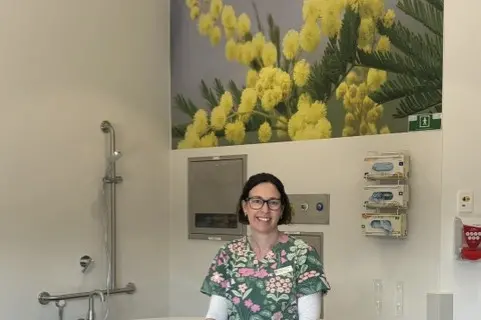
PHOTO
The new maternity unit at Cowra Hospital is already making a difference for local families, with spacious birthing rooms, dedicated neonatal facilities and new water birth pools attracting expectant mothers from across the region.
The maternity unit forms part of the recently completed $110.2 million Cowra Hospital Redevelopment and has been designed to provide modern, family centred care while allowing more women to give birth closer to home.
Cowra Hospital Maternity Unit Manager Melissa Ousby said the response from families since the unit opened had been overwhelmingly positive.
"We have had an amazing response by our women and families that have used our new Unit," she said.
"Great positive feedback and particularly about the spacious birthing rooms and the patient rooms that now offer full ensuite facilities and lots of light."
"Also more space for families and visitors in this space as well to visit our women and babies post birth."
The purpose built maternity unit includes modern birthing suites for low risk pregnancies, private ensuites, dedicated nursery facilities and upgraded technology to support both patients and staff.
One of the most talked about additions has been the introduction of dedicated water birth pools, which have quickly become popular among expectant mothers.
"The new birthing pools have proved very popular," Ms Ousby said.
"While not all women that use the birthing pools go on to birth in there, they are so beneficial in offering water immersion during the labour."
She said water immersion provides both physical and emotional benefits during labour.
"This has been proven to help reduce anxiety in women and the need for further analgesia at times."
"It's a lovely and calming space which does wonderful things to promote an increased flow of oxytocin in the mum and lead to a really positive birth experience."
Around 10 per cent of women giving birth at Cowra Hospital have already chosen to deliver their babies in the water, while many more have used the pools for pain relief during labour.
"We have had countless women use our birthing pools for water immersion and analgesia," Ms Ousby said.
"At this stage, we have seen around 10 per cent of our birthing women give birth in the water which has been incredibly positive for both mum and maternity team."
The redevelopment also placed a strong focus on creating culturally safe spaces for Aboriginal families.
An Aboriginal cultural courtyard sits alongside the birthing rooms, incorporating local Wiradjuri traditions through artwork, handprints and river symbolism to help families feel connected to Country during one of life's most significant moments.
"It was really important to us to ensure that all our Aboriginal mums and their families feel welcome and culturally safe at all times, whether they are coming in to birth their babies on Country or just for a visit," Ms Ousby said.
"Our outside courtyard that is directly linked to our birthing rooms has been specifically designed with our granite sculpture and coolamon to ensure that women and families feel a connection to country and their culture."
For babies requiring extra support after birth, the redevelopment has also delivered a dedicated nursery with specialised neonatal facilities.
Ms Ousby said the purpose-built space had greatly improved care for newborns needing closer monitoring.
"This has been a great asset in allowing a more dedicated space for those babies that might require a little bit more care after birth," she said.
"We have more fluid space for staff and allows us to access a neonatal critical camera for those babies that might need additional virtual consultation and support."
The upgraded nursery has also created a more comfortable environment for parents.
"It's also allowed mums to stay more comfortably with their babies in this space as well as providing a more private breastfeeding space for mums."
The improvements are already encouraging more women to choose Cowra Hospital for the birth of their babies.
"We are slowly starting to see an increase in our Booking In and Birthing numbers, though it's early days yet," Ms Ousby said.
"When we designed our Maternity Unit, it was with the plan to proactively increase our birthing numbers for Cowra."
The hospital has also begun welcoming mothers from neighbouring communities who may have previously travelled to larger regional centres.
"We have had women from as far as Parkes who have previously birthed in Orange or Forbes now come our way to birth," she said.
"Our new birthing pools, spacious rooms and our amazing Maternity team have definitely made an impact around the District."
For staff, one of the most rewarding parts of the redevelopment has been seeing returning families experience the new facilities.
"We feel particularly proud when we have women who have birthed with us in the old hospital and come back for another baby, and really look forward to the birth just so they can use the new rooms."
The unit has also reinstated one much loved tradition.
"We have re-instigated our beautiful thank you board that was so popular in our old unit, so we love seeing those amazing thank yous that we can share with everyone else."
Looking ahead, Cowra Maternity Services is preparing to launch another initiative aimed at supporting families after they return home.
In the coming months, the hospital will introduce its new Midwifery in the Home (MITH) program, allowing midwives to provide care and support for families during the first weeks after birth.
"This program provides midwifery care, in the home to families in the first few weeks of life," Ms Ousby said.
"This will give additional support for those early days of breastfeeding, parenting and post birth support."
She said the redevelopment had strengthened the team's commitment to providing high-quality maternity care close to home.
"Our brand new Maternity Unit has really strengthened our resolve to provide the best care possible to all women, babies and families that choose our service," she said.
"We have an incredibly strong and passionate Maternity Team consisting of our GP/Obstetricians and Midwives that is always growing."
While Cowra continues to care for women experiencing low risk pregnancies, Ms Ousby said the service also works closely with specialist obstetric teams to support women with higher-risk pregnancies before and after birth.
"Our aim is to keep women as close to home as possible," she said.
She added that the redevelopment has also improved access to maternity services through the hospital's new Medical Imaging Department.
"Our brand new Medical Imaging Department with the inclusion of ultrasound has also allowed women to access bulk billed obstetric ultrasounds, which has especially been beneficial for those women needing ongoing fetal surveillance in pregnancy."
For families across Cowra and surrounding communities, the new maternity unit is proving that high-quality, modern maternity care doesn't always require travelling away from home.