
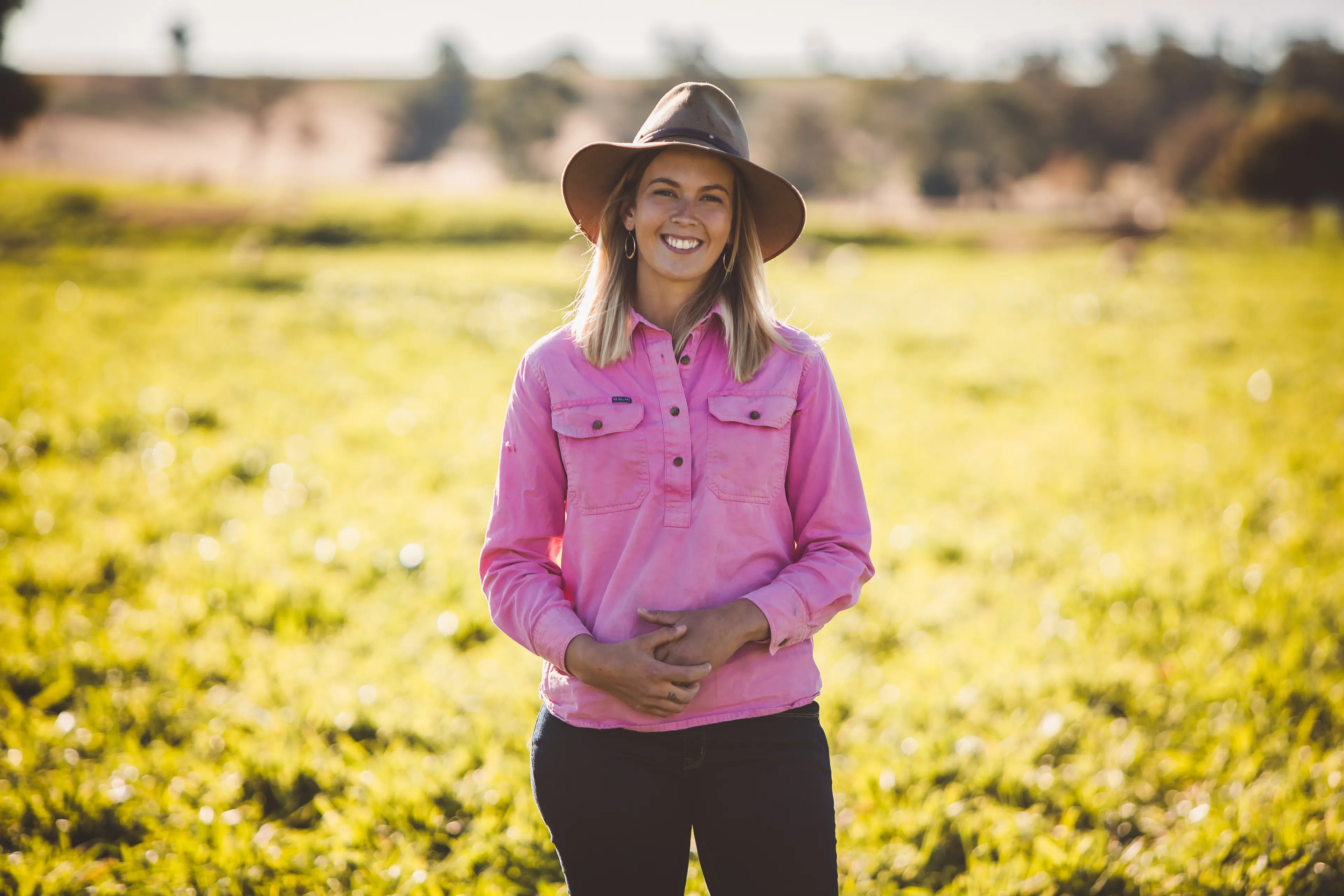
PHOTO
78411.0
For fifth-generation Cowra farmer Jo Treasure, agriculture is far more than a career.
It is a connection to generations of family who worked the land before her, an industry she hopes to help strengthen for those who come next and, ultimately, a fundamental part of who she is.
That passion has now earned Treasure national recognition, with the young farmer and agricultural educator named a finalist for the Nutrien Ag Solutions NextGen Agri Leader Award at the 2026 Australian Agriculture Awards.
The award recognises people aged between 18 and 35 who demonstrate a desire to improve economic, environmental or social outcomes within their farming business, organisation or the broader agricultural sector.
For Treasure, the recognition comes after a journey into farming that was not always part of the plan.
“Farming is more than just my job. It’s who I am,” she said.
“I feel a really deep connection to our land and the work that we do and the service that we provide feeding the country.”
As the fifth generation of her family to farm, Treasure said she was conscious of the work that had gone into building the operation she is now part of.
Technology and mechanisation may have transformed agriculture, but for Treasure, those advances have also given her an even greater appreciation for what previous generations achieved.
“Looking at how much easier it is for me in terms of mechanisation and investment in technology, how much easier it is for me compared to my dad, and how much easier it was for him compared to my grandfather, I really want to honour all the hard work of the people that came before me,” she said.
Despite that deep family connection, Treasure did not grow up convinced agriculture would become her future.
The youngest of four children, she instead imagined an academic life in the city.
“I was a bit of a nerd at school,” she said.
“I was really studious and studied really hard in Year 12, and I wanted to become an academic and go and live in Sydney.
“Then I started working on the farm in my gap year and just never left.”
What began as a gap year job instead became a career and a connection to the land that Treasure found difficult to walk away from.
Part of that attraction is the sheer variety farming provides.
“I love the variety of my job,” she said.
“There’s always something different.
"You never finish learning.
"There’s always something else you could be mastering or looking into or focusing on.”
That life has also reinforced her appreciation for Cowra and the opportunities available in regional communities.
“I think Cowra and our farm, and I guess our region in general, is just a great place to have a family and raise kids and pursue your dreams,” Treasure said.
Her pathway has not been without challenges.
Agriculture has traditionally been a male dominated industry, and Treasure said she had encountered adversity as a young woman working within it.
However, she believes attitudes have improved considerably during her time in the sector.
“To put a positive spin on it, it’s gotten exponentially better since I first started in ag,” she said.
“I’ve always tried to use that kind of adversity as motivation.
“That adversity is there, but I think you’ve just got to take it in your stride and use it as an excuse to prove people wrong.”
While attitudes may be changing, Treasure believes the next generation of farmers faces significant economic barriers.
The rising price of agricultural land and increasing operating expenses are among the challenges she sees confronting young people hoping to establish themselves.
“Definitely the cost of land,” she said.
“Our expenses are rising exponentially, and the corporatisation of farming is making it hard to be a middle-sized farmer.”
Treasure also pointed to the challenge of attracting and retaining people who do not have an ownership stake in a family farming business.
She said agriculture could involve demanding work even when someone was building their own operation, making the proposition particularly challenging for employees without the prospect of eventually buying into the business.
Those realities make encouraging young people into agriculture particularly important.
For Treasure, that begins with helping people better understand what farmers actually do.
She believes there remains a significant gap between the food consumers pick up from supermarket shelves and their understanding of the work required to produce it.
“There’s definitely a massive disconnect between the food people buy at the supermarket and what producers actually do,” she said.
“Even in Cowra, where people kind of know or have an appreciation for farming, a lot of people don’t understand how much goes into producing some of their favourite foods.”
Education, particularly among children, is one way Treasure hopes that divide can be narrowed.
“I think it’s really important for our kids to understand where their food comes from, so that they can, I guess, pass that information on to city kids when they leave high school,” she said.
“No matter what happens, food is always going to be something that we need. So it’s important that people understand where it comes from.”
It is a perspective that fits closely with the NextGen Agri Leader Award, which seeks to recognise young people demonstrating leadership and a desire to be change-makers within Australian agriculture.
Treasure’s own advice to other young women and young farmers is to seek out those connections rather than feeling they need to find their way through the industry alone.
“Life is what you make it,” she said.
“Make sure you reach out to the other people in your industry that you look up to.
“One thing I’ve found is that people are more than willing to help if you need it, and the world is your oyster, so just go for it and see what happens.
“That’s all I’ve ever done.”
For a young woman who once expected her future would take her away from Cowra and towards an academic life in Sydney, that approach has instead led her back to the same land her family has worked for five generations.
Now, as a national award finalist, Treasure is helping ensure that history is not simply being continued, but carried into a new generation of Australian agriculture.