
PHOTO
A 2026 household kerbside bin audit has found Cowra residents are already diverting a significant proportion of waste from landfill, while also highlighting major opportunities for improvement ahead of a planned Food Organics Garden Organics rollout by 2030.
The audit, conducted by EC Sustainable and funded through the NSW EPA as part of a joint project with Weddin and Hilltops councils, analysed the contents of bins from 160 households across the Cowra Local Government Area. The results will help inform future waste strategy and the implementation of a FOGO service.
Council was told the audit provides a detailed snapshot of household waste behaviour, including contamination rates, recycling recovery, and the volume of organic material currently being disposed of in general waste.
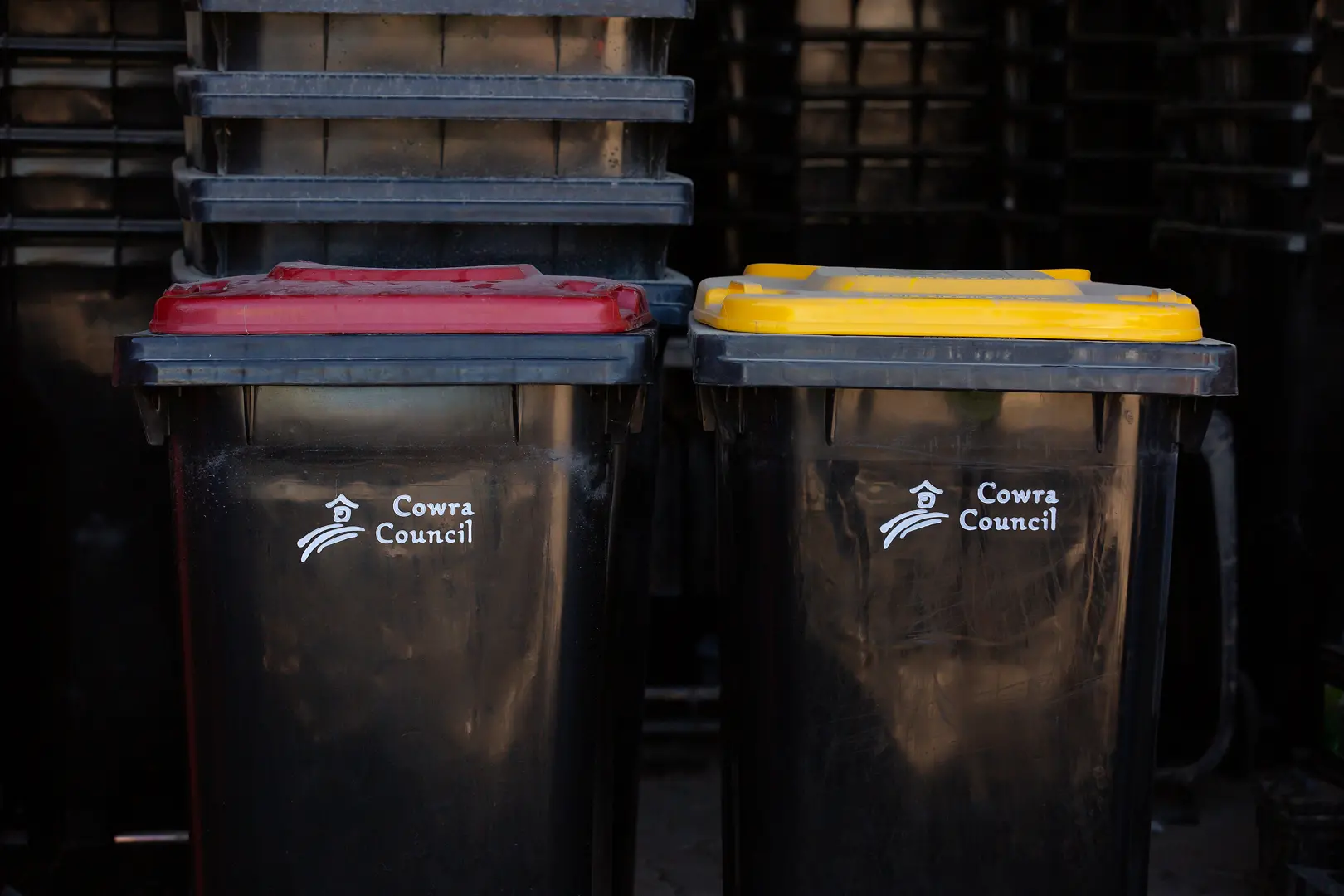
On average, households were found to generate 11.5kg of waste per week in red-lid bins, alongside 2.84kg of recycling in yellow-lid bins. However, the audit identified a contamination rate of 19.8 per cent in recycling bins, meaning nearly one in five items placed in recycling should instead be disposed of as general waste.
A further 4.608kg of food organics and garden organics (FOGO) material was found weekly across both red and yellow bins per household, with an additional 0.736kg of containerised food organics potentially recoverable.
The report found that 14.5 per cent of material in red bins was actually recyclable, including paper, plastics and glass.
Despite contamination challenges, Cowra households achieved a 15.9 per cent diversion rate from landfill through kerbside recycling, consistent with existing Council reporting.
The audit also found that up to 27.5 per cent diversion could be achieved if recyclable material currently being placed in red bins was correctly recovered. If a FOGO service were introduced, overall diversion from landfill could rise to 59.3 per cent, representing an estimated additional 22 per cent diversion from current levels.
However, the report noted that total waste weight would likely increase under a FOGO system due to the inclusion of heavier garden organics.
The audit also compared behaviour between households using different bin sizes.
Households with 140L general waste bins used 73.6 per cent of their capacity and had a 17.4 per cent recycling contamination rate. Larger 240L bins were used at a higher rate of 77.1 per cent for waste and 80.2 per cent for recycling, but recorded a higher contamination rate of 21.2 per cent.
The report suggested smaller bin users were generally more efficient recyclers, with a higher resource recovery rate of 63.8 per cent compared to 54.1 per cent for larger bin households.
A total of 98 hazardous items were identified across sampled bins, including 57 electronic items and 29 dry-cell batteries.
The audit reinforced the importance of keeping hazardous waste out of kerbside systems and continuing to promote Council’s Community Recycling Centre (CRC) as the preferred drop off location.
The report recommends Council use the findings to inform the design of a future FOGO system and waste strategy, while also prioritising education campaigns to reduce contamination in recycling bins.
Other recommendations include relaunching recycling education programs, improving awareness of correct bin usage, increasing recovery of recyclables from red bins, and continuing “never bin a battery” campaigns to reduce fire risk.
Regular seasonal waste audits were also recommended to track changes in behaviour and account for variations in waste composition due to weather and gardening activity.
Councillors broadly welcomed the findings, with Deputy Mayor Councillor Nikki Kiss saying the audit provided valuable clarity on household waste habits and challenged assumptions about bin size and contamination.
“I actually had to read it a few times myself,” Cr Kiss said.
“I know there’d been some discussions about the potential for additional contamination in yellow bins where people have smaller red bins… and it turns out it’s actually the exact opposite.”
She said households with larger bins showed higher contamination rates, contrary to expectations.
“People with larger waste bins had a 21 per cent greater degree of contamination in their yellow bins,” she said.
Cr Kiss said the results highlighted the importance of education and behaviour change rather than punitive measures.
“It’s all about education, pulling together and making us all a bit more conscious of the fact that we’re all leaving a footprint,” she said.
She also noted that smaller bin households appeared more engaged in correct recycling practices.
“I think that’s really interesting about how much information is garnered there,” she said.
Councillor Erin Watt said the audit provided “fantastic insight” into the future rollout of FOGO, noting that nearly half of current landfill waste could potentially be diverted.
“Of the average 11.5 kilos of waste bin, 4.6 kilos of that was FOGO,” Cr Watt said.
“So this gives us really good insight into the amount of waste that could be diverted that’s sitting in there already.”
She said education would be critical, particularly in addressing contamination and “wish cycling”, where residents incorrectly place non-recyclable items into yellow bins.
“There’s a really good reflection here of people thinking certain plastics are recyclable, putting them in and hoping for the best,” she said.
Cr Watt also highlighted opportunities to expand battery and hazardous waste drop-off points.
“It’s easy, as opposed to driving up to the tip with two or three batteries,” she said.
Mayor Paul Smith said the results would help Council prepare for the introduction of FOGO and improve community understanding of recycling rules.
“I agree there was a bit of angst when we told people we were going to go through their bins,” the Mayor said.
“But I think the results prove it was worth doing.”
He said Council should continue strengthening education efforts.
“I think we’ve probably got to hit a bit harder with our recycling message,” he said.
The audit concludes that Cowra is performing at or above comparable regional benchmarks in waste diversion, but significant gains remain possible through improved recycling education and the introduction of a FOGO service.
If fully implemented, FOGO could lift diversion rates above 50 per cent, substantially reducing landfill reliance and reshaping how household waste is managed across the Shire.